
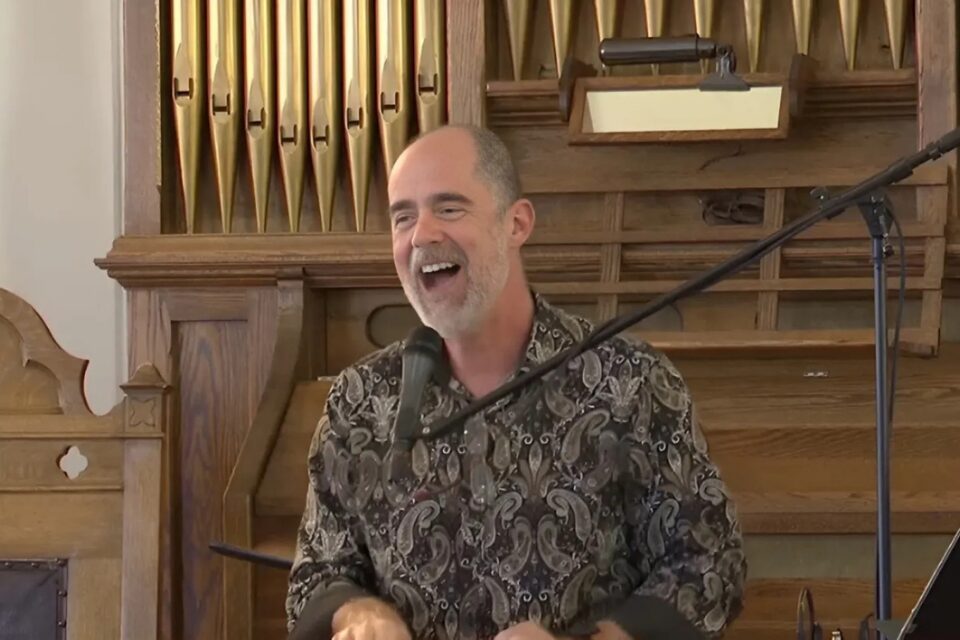
Continuing our Lenten series on United Methodist identity and beliefs, Phil Lynch explains how heartfelt, expressive worship paired with doctrinal study became a hallmark of Methodism.
PHIL LYNCH
Escanaba: First UMC
Editor’s note: This year, the Michigan Conference is focusing on rediscovering what sets us apart as United Methodist Christians. Conference leadership invites every local church to plan a study of Laceye Warner’s “Knowing Who We Are: The Wesleyan Way of Grace.” This book offers a clearer picture of our Wesleyan way of following Jesus. Read this article to learn more.
Imagine a world where a Sunday evening church service is so popular that you need a ticket to get in. And how do you get your admission ticket? Oh, simply by attending a group meeting every week for three months, being asked in public, “How does your soul prosper?” and speaking about your temptations, sins, and progress in the faith.
And why do you want to procure this ticket and attend Sunday evening services?
In short: the singing.
This was the Methodist world in England in the mid- to late-1700s.
I wasn’t alive then — though it’s starting to feel that way, some days — but I’ve read that the Church of England just wasn’t very . . . stirring. Whereas the singing Methodists, a revival movement within the church, really knew how to rouse drooping spirits — by singing “lustily and with good courage,” as John Wesley directs us at the start of our hymnal.
It’s a commonly used phrase that “Methodism was born in song.” Well, this was literally true. A group of Moravians introduced the Wesleys to a deeply experiential, disciplined form of Christian devotion, emphasizing heartfelt piety and communal singing. On the voyage to Georgia, their calm faith and constant hymns during a storm impressed John Wesley, giving him a sense of trust in God’s providence. Back in England, their singing at Moravian-influenced meetings reinforced communal spiritual awakening, encouraging the Wesleys to value heartfelt, expressive worship alongside doctrinal study.
John himself wrote in his journal in 1743, “Our main help is the use of those hymns which God has provided for us. . . . I am persuaded that the singing of these hymns has been a great means of increasing the power of religion in the souls of many.”
In “The Burning Heart,” A. Skevington Wood observes that hymns were the “chief vehicle” for the revival’s message, and that “the Methodist societies were essentially singing communities,” where the music provided an emotional and spiritual attraction that traditional services lacked.
Frank Baker, the eminent Charles Wesley scholar, notes: “The hymns of the Wesleys were not merely an accompaniment to the revival; they were the revival itself in song,” and the “infectious joy” of the singing was often what first drew outsiders into the meetings.
Do you have some memories of hymn singing that really moved you?
I’m remembering rousing services at Adrian College when Annual Conference was held there, and there would be a big choir leading the huge congregation, plus brass and maybe tympani. Terrific and soul-stirring!
Closer to home, at Escanaba: First UMC, we would sometimes process in to “Lift High the Cross.” I can hear our organist, Eric Chapman, doing a slight ritard, or slowing down, before we would hit each chorus again. Recently, my wife and I teared up while singing “Shine, Jesus, Shine” in worship, thinking back on our deep and treasured memories of Camp Michigamme.
I’ll bet there are some Christmas and Easter hymns that really move you, too. This weekend, we celebrate Palm Sunday, and I can’t wait to be belting out “All Glory, Laud, and Honor.”
One of the reasons I was asked to write this installment of the Lenten series on Methodist distinctives is my lifelong hobby of setting the hymn texts of Charles Wesley to new tunes.
As the Methodist movement took off, it was the hymns (poems) that John’s brother Charles wrote that became the primary hymns Methodists sang. They’re really great: personal and emotional, while expressing deep thoughts in cool language. Almost all the hymns in John’s first great collection, published in 1780, are by Charles. And upon Charles’ death in 1788, John said, “His talent for hymn-writing was unique. No one ever wrote such hymns as he did, and no one ever will.”
According to the aforementioned scholar Frank Baker, Charles wrote, oh . . . only about 8,989 hymns! A real lightweight, don’t you think? Granted, some are only one stanza long, but many are among the most-sung hymns in Christendom:
-
- “Hark! the Herald Angels Sing”
- “Love Divine, All Loves Exceling”
- “O for a Thousand Tongues to Sing”
- “And Can It Be, That I Should Gain?”
- “Christ the Lord Is Risen Today”
- “Jesus, Lover of My Soul”
- “Come, Thou Long-Expected Jesus”
- “Rejoice, the Lord Is King!”
Now I admit, taking poems from the 1700s and fitting them to new musical garb is a quirky hobby. (It’s called re-tuning, by the way, and I am far from the only guy out there doing so!)
For me, it goes all the way back to the 1990s, when, as a young man, I first learned about our rich heritage. Our church and its pastor, Mike Peterlin, really stressed those things. While a Course of Study student at Garrett-Evangelical Theological Seminary, I discovered in their library old volumes from the 1860s of Charles’ poems as originally issued.
Score!
Over the years, I’ve been privileged to lead these refreshed versions of classic hymns in worship throughout the Upper Peninsula and at Garrett. My most recent collection, the album “Love Divine,” focuses on hymns that are about entire sanctification.
In short, it’s the idea that God is at work changing your nature to be his, so that every act, word, and thought might be love. God became mortal that mortals might become God, as Athanasius put it.
By the way, it’s the idea John Wesley perceived God had bothered to raise up the people called Methodists in the first place.
I’ve been concentrating on hymns with this focus because that’s what resonates with me the most right now. That salvation is not just a rescuing from future death or torment (or “fire insurance”). It’s also a healing in the here and now.
Here’s the stanza I used as a chorus in “O for a Heart to Praise My God.” I think it makes a lovely prayer for one’s own, a continued inner conversion, to be fully in tune with Love Divine:
Thy nature, dearest Lord, impart,
Come quickly from above,
Write thy new name upon my heart,
Thy new, best name of love.
Phil Lynch’s new album, “Love Divine: The Charles Wesley Project,” streams on all major platforms. Accompanying liner notes, articles, and signed copies are available at www.lovedivineproject.com. Phil also invites inquiries about his presentations for worship services and workshops. For booking inquiries, visit www.phillynchmusic.com.
The publication of this article was made possible thanks to generous financial gifts from local United Methodist churches in Michigan through Ministry Shares. Thank you! Learn about the impact of Ministry Shares on mission and ministry in Michigan and around the world.
Last Updated on March 30, 2026