
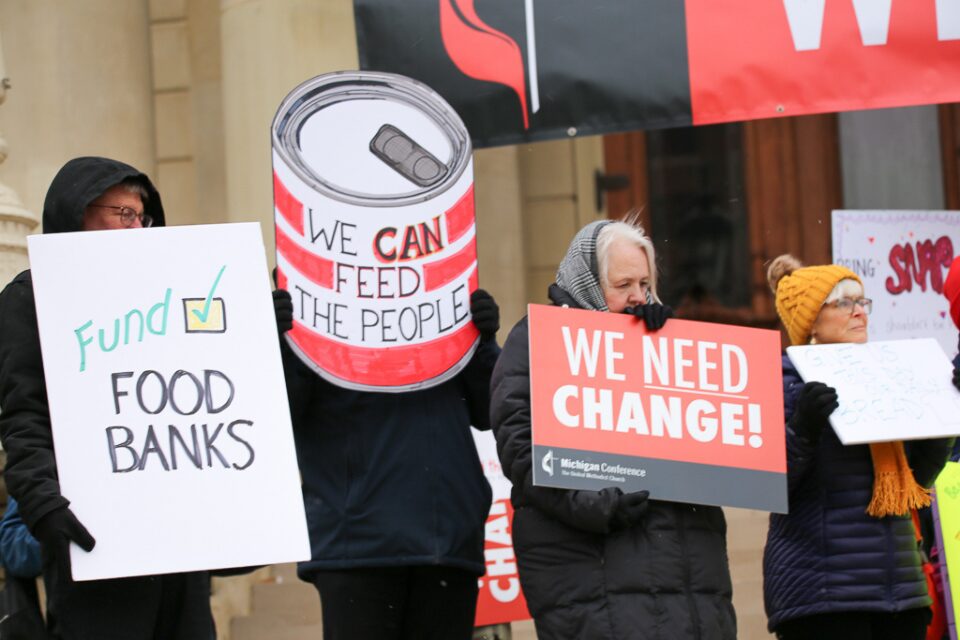
Nearly 300 United Methodists and friends journeyed to Lansing for Advocacy Day to urge continued state funding for food security programs.
JAMES DEATON
Content Editor
LANSING, Mich. — Despite below-freezing temperatures, nearly 300 United Methodists and ecumenical friends gathered at the State Capitol to meet with lawmakers for the Michigan Conference’s annual Advocacy Day on March 18, 2026. This marked the fourth consecutive year of advocacy on a timely justice issue, this year focusing on hunger and food insecurity.
Pastors and church members, including United Methodists, Presbyterians, Episcopalians, and others, filled Central UMC, the event’s host. Advocates used the warm space to prepare their personal stories and remarks before crossing the street for the rally on the Capitol steps and attending the 85 scheduled meetings with state senators, representatives, and their staff.
From one lakeshore to another, faithful Christians traveled from Saginaw, Traverse City, Detroit, Muskegon, and many points in between to witness for their neighbors facing the ongoing hunger crisis in our state. They told stories of what they see and hear as their local churches or nonprofits work to alleviate hunger in their communities. Many United Methodist churches have feeding ministries, so they are doing their part, but they need continued state funding to strengthen food banks and other programs across Michigan that they depend on.
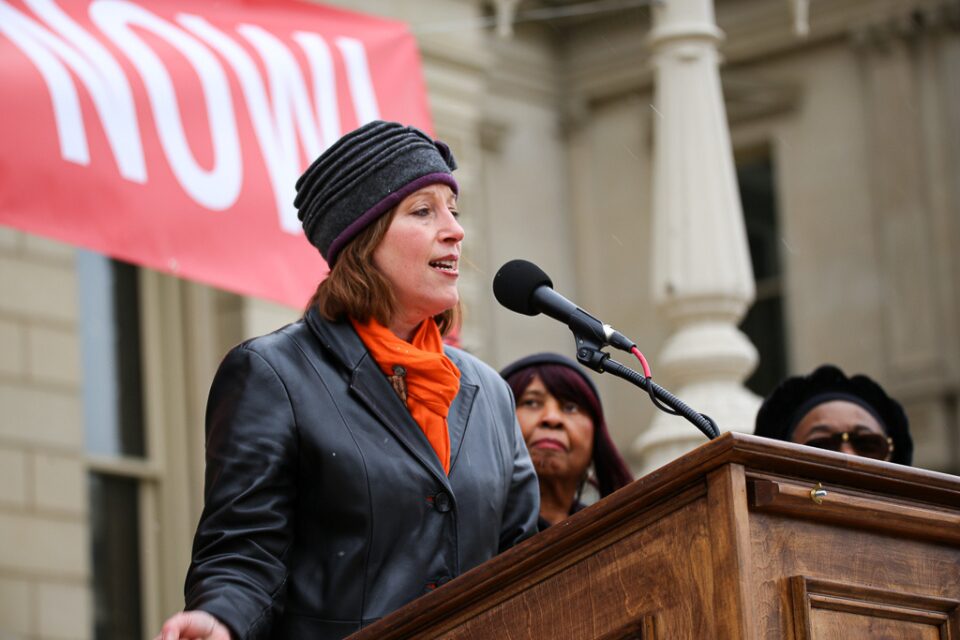
Rev. Fitzgerald asked state lawmakers the same question and then boldly answered it: “You can help us by advocating for the least of these who are your neighbors and your constituents. You can help us by listening to the heartbreaking stories that we will share and by not turning a deaf ear. You can help us by funding projects that support food security and lead to the health and flourishing of all people in our great state of Michigan.”
Statistics show that many Michiganders face hunger as a painful reality. Food insecurity has increased in our state from 14.2% to 15.4%. As grocery prices continue to rise, wages have not kept pace, leading to increased hunger. This has affected vulnerable populations, including veterans, children, and seniors. According to a 2023 study, over 131,000 Michiganders age 60 and older (roughly 5.3%) live with some form of food insecurity, or a lack of regular access to nutritious meals.
Adding to these problems is the projected 2027 state budget shortfall of $1 billion, along with reductions in federal support for state programming. This means every line item in the budget is open to debate and could be cut, including essential programs like free breakfasts and lunches for schoolchildren, as lawmakers grapple with the tough task of balancing the budget.

There has been bipartisan support for funding food banks and feeding programs in our state, and United Methodists and friends who came to Lansing for Advocacy Day wished to thank lawmakers for their past support. When federal funding for Supplemental Nutrition Assistance Program (SNAP) benefits was paused last November, state legislators voted to release $4.5 million in emergency funds to the Food Bank Council of Michigan to assist hungry Michiganders.
When the funds were delivered, the Food Bank Council mobilized to distribute $4.5 million in food through its network of seven regional food banks, providing about six million meals over three weeks. Many United Methodist feeding ministries depend on this strong network of food banks to assist neighbors. The Food Bank Council was this year’s partner for Advocacy Day.
United Methodists and friends brought words of gratitude to the Capitol, including letters and cards from those who could not be there in person, thanking their lawmakers for providing the emergency aid last fall and for funding free breakfasts and lunches for children in the 2026 budget. But they also urged legislators to continue funding essential programs for 2027, despite anticipated budget cuts, as hunger rates continue to climb to levels not seen in years.
Grounded in faith principles from Scripture and our Wesleyan tradition, United Methodists believe that God calls us to feed our neighbors who are hungry and to advocate for ending social and political barriers that prevent everyone from being fed.
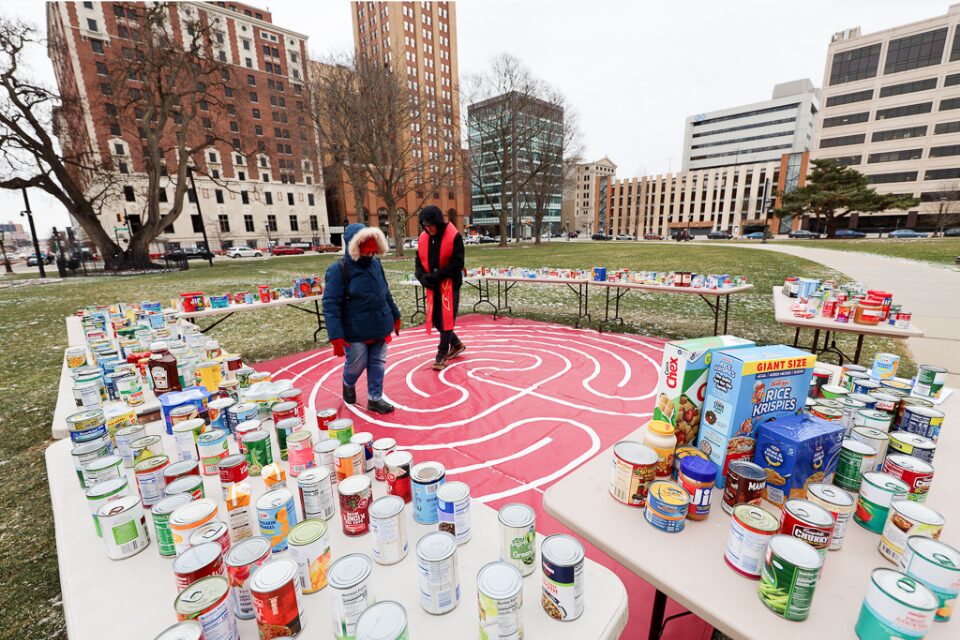
Our 2020 / 2024 Social Principles state that we are to be in active ministry with impoverished communities “by sharing the good news of Jesus Christ and by supporting their efforts to secure equal opportunities and meet human needs, including food, water, health care and education.” This also means committing to eradicate “unjust practices, policies, and systems that have condemned entire generations to live in unrelenting poverty.”
In “The United Methodist Church, Food, Justice, and World Hunger,” the 2020 / 2024 Book of Resolutions states that the Holy Spirit moves today to tear down unjust structures and impels us to take action, even when perfect solutions are not apparent. It continues: “We engage in the struggle for bread and justice for all in the confidence that God goes before us and guides us. That struggle includes examination of our personal and congregational lives in the light of God’s love and concern for all and Jesus’ question, ‘Who is our neighbor?’”
So, in essence, United Methodists are activating their discipleship through acts of mercy — feeding people who are hungry — and justice — working to eliminate policies and systems that keep people in poverty and effecting change. And by keeping “Who is my neighbor?” central.
Michigan United Methodists came to Advocacy Day with stories of how they are fulfilling these mandates and living out their faith in their local churches and communities.
Dick Mieskowski is an active member of Grand Rapids: First UMC, an urban congregation that actively partners with other churches and nonprofits to address food insecurity in Michigan’s second most populous city.
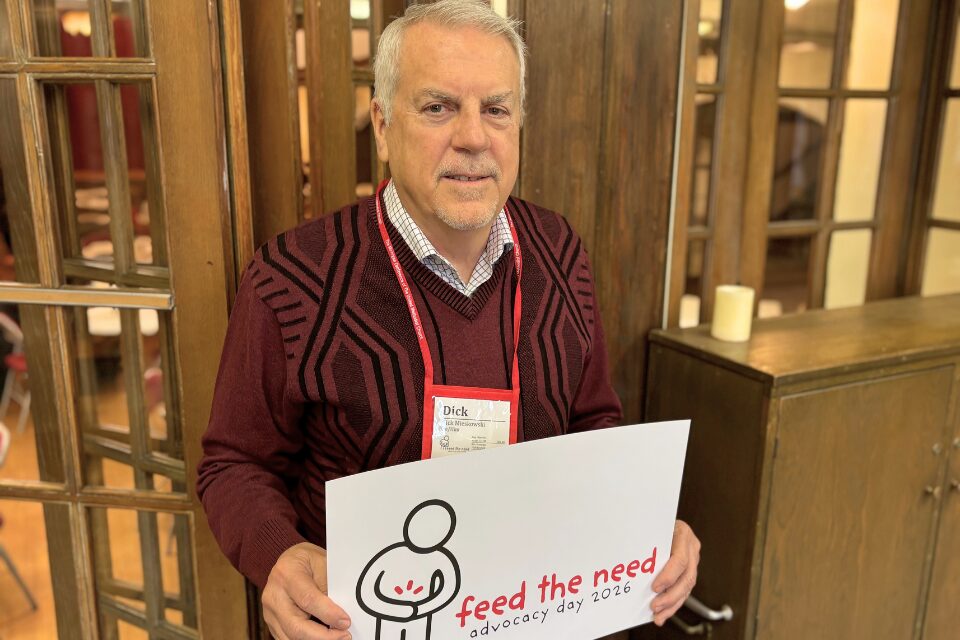
In addition to Grand Rapids: First UMC’s own Work Program, which offers short-term work opportunities with breakfast for people who are unhoused or living in poverty, the congregation is among several churches and nonprofits supporting a new Community and Service Center hosted by Westminster Presbyterian Church. This ministry serves as a warming and resource center for downtown residents experiencing homelessness. It provides a daily lunch and resources for housing, medical care, and other essentials.
Mieskowski values the collaboration he observes among churches and other ministries in Grand Rapids. “I just love the idea that we’re not all reinventing the wheel,” he said. “Just like we’ve supported Westminster’s food pantry because they’re our neighbors, they’re walkable from our church. Why have one when they have one? Let’s work together and help support that. So we do times of extra giving in our church and take donations over to them.”
Dick came to Advocacy Day with these stories, along with a more personal one. For six years, Mieskowski has been volunteering eight to ten hours a week at Kids’ Food Basket, which supports children in four West Michigan counties — Kent, Allegan, Ottawa, and Muskegon — with healthy sack suppers and nutritional education.
“I have a daughter who’s a teacher, and she has kids who come to school hungry. So once I retired, I looked to Kids’ Food Basket. I volunteer because to me, that’s something tangible that’s helping to feed kids. Sure, I support food security with my vote, my finances, and my prayers, but I can go in and coordinate a shift of volunteers to assemble 2 to 3,000 sack suppers that go out the next day. Kids’ Food Basket has seen great results in schools, with improvements in behavior and truancy, and test scores go up once they get involved with the school.”
He continued, “Part of what I told my legislator is that we’re already out there, and I’m willing to do this as part of my faith calling, but we can’t do it all. And thus, we’re encouraging them to continue supporting budget items that address food security, like school lunches. I don’t want to see that program go away because Kids’ Food Basket is only offsetting that. It couldn’t begin to replace it. So, we are advocating to make sure that continues even with budget challenges.”
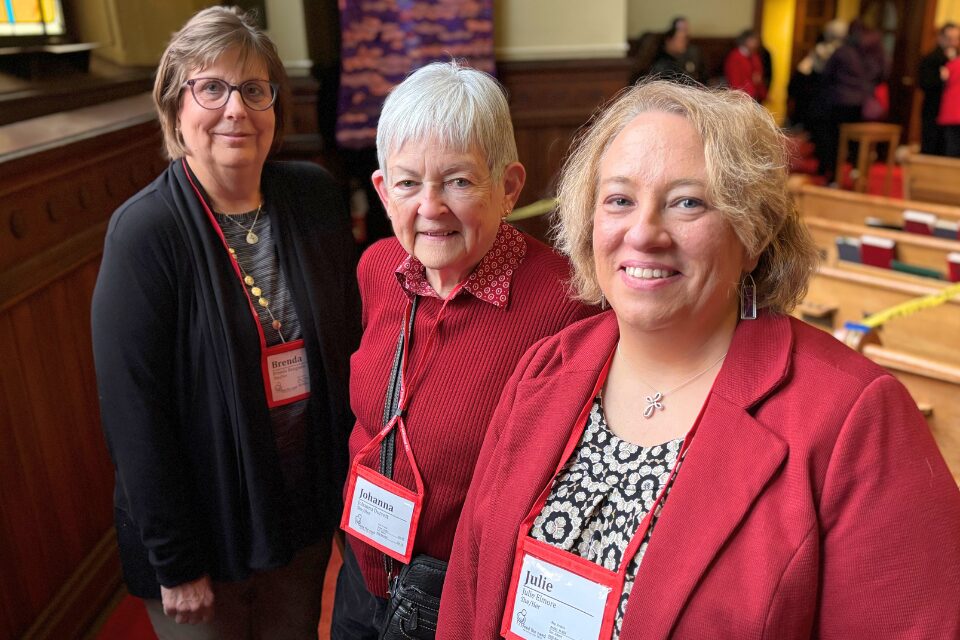
Trinity Community Development & Neighborhood Center in Battle Creek was born out of a three-church merger in 2018 among the Trinity, Birchwood, and Chapel Hill United Methodist congregations. Worship and administrative functions were combined at Chapel Hill, Birchwood was purchased by a Burmese congregation, and Trinity was retained with the goal of creating a connectional place in the midtown Battle Creek neighborhood. The Trinity facility remains under Chapel Hill ownership but is now managed by its own nonprofit board.
Trinity is a neighborhood center that hosts AA meetings, Girl Scout groups, exercise groups, two churches that meet there, and other community groups and events. However, its robust feeding ministries serve as the core of its work. This is in large part because Trinity is located adjacent to the zip code with the highest food insecurity rate in Calhoun County, 49037. Essentially, it’s in a food desert with limited access to grocery stores or fresh, nutritious food.
Trinity Neighborhood Center offers a drive-thru fresh food distribution through the South Michigan Food Bank, runs a monthly client-choice food pantry, hosts a pop-up food pantry every Friday, and has an emergency food program, among other services. With just two staff members and a host of committed volunteers, it’s a busy hub working to feed neighbors in need and change the narrative around those who receive food benefits.
Brenda Bengtsson came to her first Advocacy Day with Johanna Durrett and Rev. Julie Elmore, pastor of Battle Creek: Chapel Hill UMC, to tell Trinity’s story and advocate for continued support of feeding programs in Michigan.
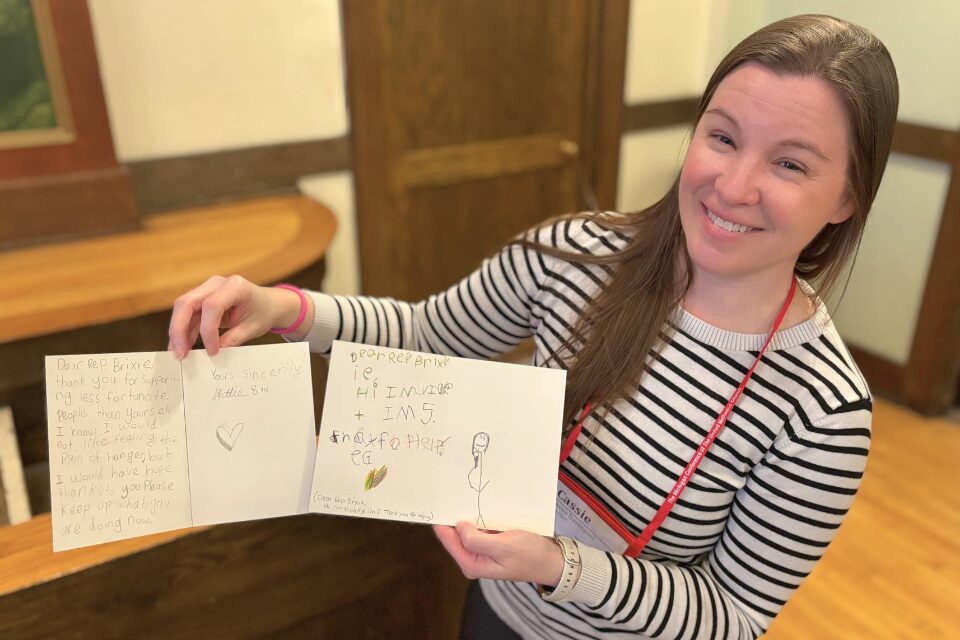
“We’ve gotten to know the people because they come all the time,” said Bengtsson. “And each story is different. Some are tragic; there are a lot of people living in nearby hotels, and they don’t have ways to prepare things like roasts and chickens because they’re trying to feed their families with a toaster oven. We’ve even had to buy a bunch of can openers because people didn’t have them. But there are a lot of grandparents raising their grandkids. There are a lot of seniors. Many people have told me they never thought they would be in this position. Unfortunately, the perception is, ‘Oh, they’re just deadbeats. They don’t want to work.’ It’s not that at all. Look at the circumstances with inflation, rising food costs.”
Trinity is creating bonds between neighbors in this part of Battle Creek. Brenda noted, “The interesting thing is a lot of our volunteers for these food events are our customers. Together, we have done a really good job of integrating our clients, and they love it.”
Johanna Durrett told a couple of stories that highlight this relationship-building and the mutual care this ministry is cultivating: “For the pop-up pantry, there’s this one person who’ll go through and think of produce and then go home and make soup and bring it back to serve the other volunteers on another day. We also get a lot of bananas because they turn brown really fast. So, there’s another neighbor who takes them and comes back with loads of banana bread to pass out to the other volunteers, the staff, and everybody else. So, not only are they getting the food they need, but they’re also taking some of that excess and sharing it back out. That’s pretty cool.”
Durrett also commented on the abundant blessings they received recently during a Friday pop-up pantry. Trinity sent for a fresh food pick-up at a local Aldi. When they arrived, they were faced with a significantly larger pick-up since the Aldi in nearby Union City, which had no electricity because of recent tornado damage to the community, could not receive food until power was restored. The food was diverted to the store in Battle Creek.
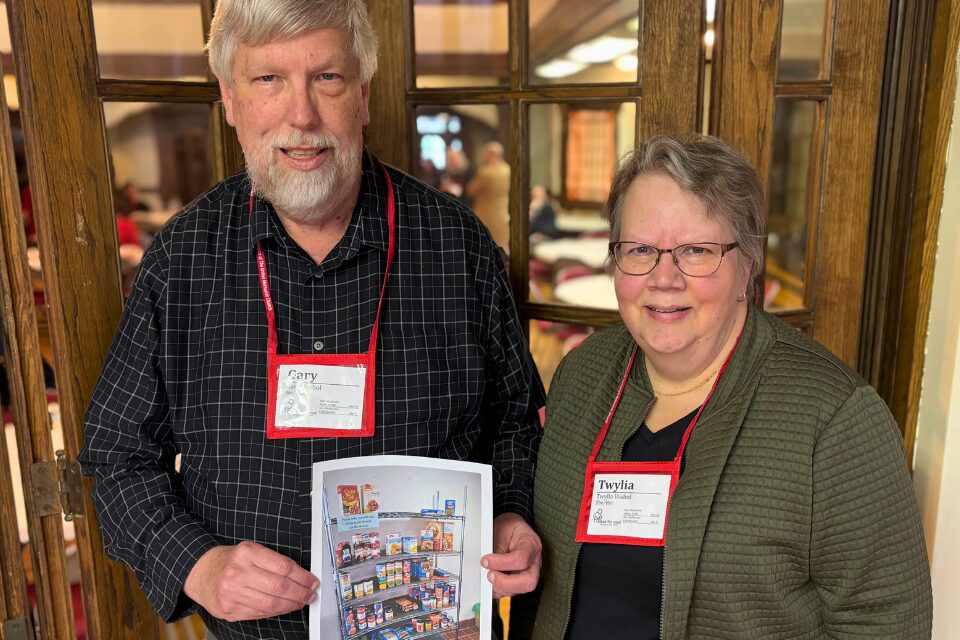
“So we were very generous that day,” said Durrett. “We had excess. Even our neighbors left with lots of stuff. But what gets me is that unless the infrastructure was there — the grocery stores work with the food bank, and the food bank gives us food and other food pantries in town — food cannot move through and get to people.” And the state needs to support that infrastructure through ongoing funding, said Durrett, and that’s the story she told lawmakers on Advocacy Day.
Rev. Erin Fitzgerald, Sue Crapo, and MJ Harting-Mincwick from Marshall UMC came to Lansing to champion the funding of food-related programs in Michigan. They brought homemade rally posters and a packet of 60 letters from church members to give to lawmakers, expressing thanks and urging continued support.
Pastor Erin praised her busy congregation, which is wholeheartedly on board with supporting feeding ministries within their faith community. She noted, “We have an amazing cohort of volunteers. I would say over half of our church membership is involved in food insecurity initiatives in some form or fashion, whether they’re cooking the community meal, distributing the fresh food boxes, working in the community garden to water or weed, or giving money directly to the food pantry.”
The motivation to get involved comes from a variety of places, she says. “I think they do see the biblical mandate of feeding their neighbors. And I also think they desperately want to do something in this broken, hurting world. And we may not have a lot of control over whether we’re at war with Iran. We may not have control over big hot-button issues, but if we can feed a family, that feels impactful.”
Feeding ministries are simple ways to engage people, and the beauty of many of them is that they can become intergenerational service projects.
Pastor Erin said, “It’s so easy for kids to say, ‘I can fill out a postcard for a senator or representative. I can bring a canned food item for a food drive. I can load this box into this person’s trunk.’ And I end up signing dozens of community service hour reports for high school kids who come to help. It’s important to see that even children have agency and can be advocates for the least of these.”
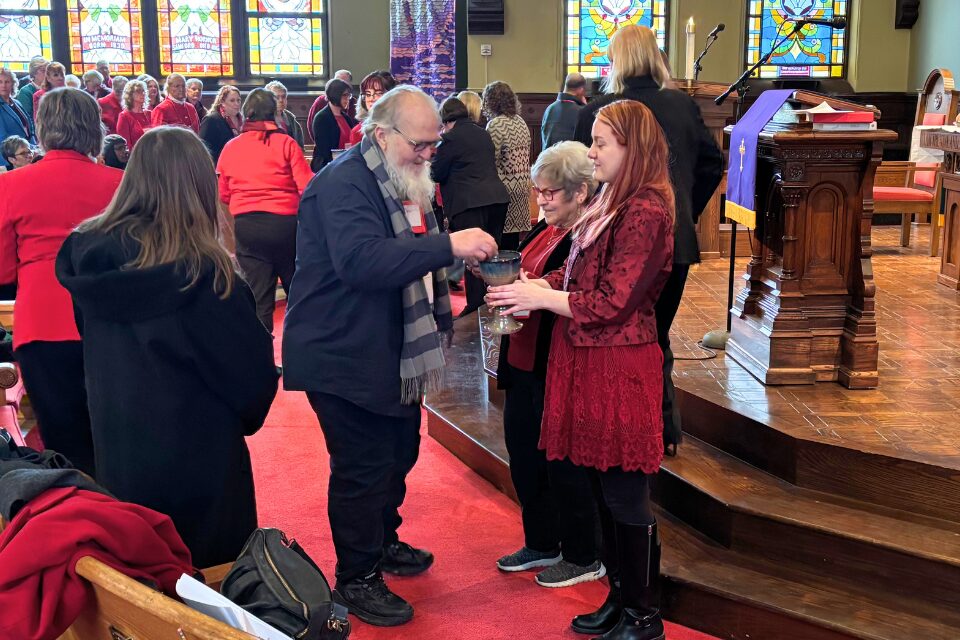
“Marshall’s a tight-knit community,” says Pastor Erin, “and I think that’s one of the things that lets us be so successful is that we can leverage our social capital and really network with other helping professionals.”
The local church is also building relationships with nearby farmers and hunters. Pastor Erin mentioned, “One of the fun things about the fresh food distribution is that we can partner with different local farmers. And so if there’s extra sweet corn to give away, we can do that. Watermelon is a big one in the summer. And then we’ve had extra meat to give away as well because farmers will sometimes donate beef if they are butchering, and then we can have hunters. If they have venison, as long as it’s processed by a USDA-certified butcher, they can donate it. So we gave out 125 pounds of venison this year in November during the SNAP benefit cuts. And then a local cattle farm gave us 125 pounds of ground beef, which we were able to distribute as well.”
Advocacy Day is made possible by a team of staff and volunteers and includes months of logistics and networking. And the day itself empowers people to give voice and listen all year long. Advocacy Day is financially supported by the Michigan Conference Board of Justice and the Episcopal Fund, both of which are funded by Ministry Shares. Support from the Episcopal Fund was guaranteed for three years; this year it ends, so Advocacy Day leadership must raise funds to make the event sustainable. Next year and going forward, they will need to fundraise $15,000 and adjust accordingly with the movement. Would you like to give toward future Advocacy Day events? If so, download this brochure to learn more and spread the good news.
Last Updated on March 31, 2026