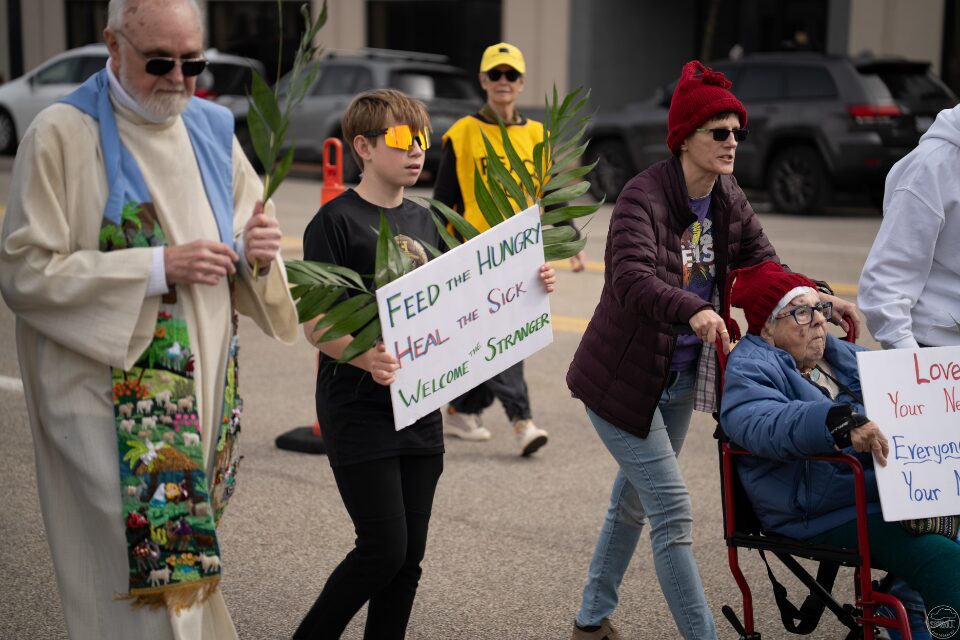
United Methodists joined hundreds of Christians from over two dozen denominations for Palm Sunday Path Michigan, a public witness for values at the heart of their shared faith: feeding the hungry, healing the sick, and welcoming the stranger.
JAMES DEATON
Content Editor, Michigan Conference
RACHEL ROSE
Director for Communication, Episcopal Diocese of the Great Lakes
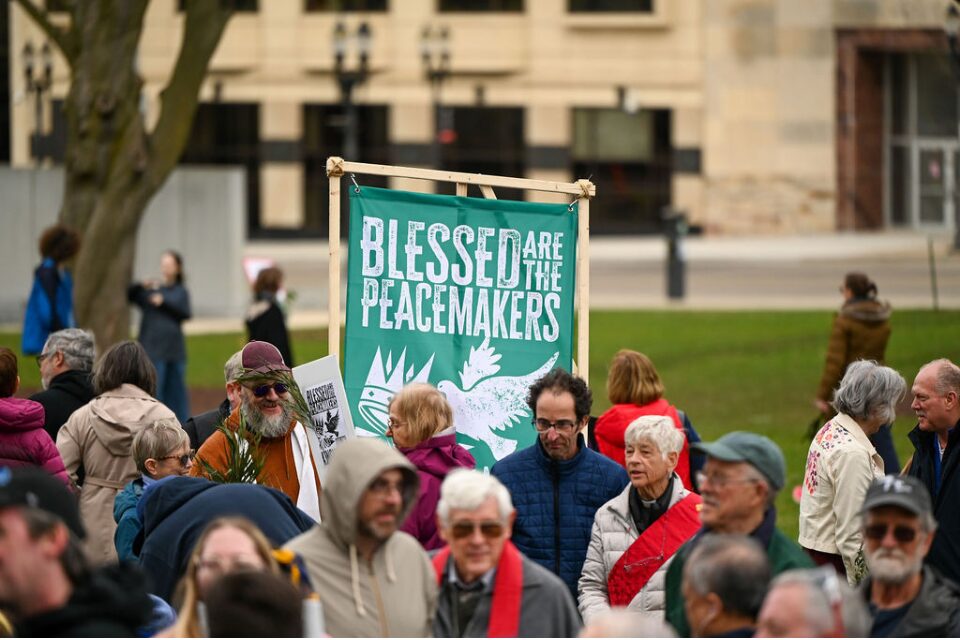
LANSING, Mich. — On Palm Sunday, over 800 Michiganders from nearly 30 Christian denominations and those with no formal affiliation at all walked together through the streets of Michigan’s capital city as an act of public witness in support of the marginalized.
The procession, which extended almost two city blocks from Pilgrim Congregational United Church of Christ to the Michigan State Capitol, brought together marchers from all generations united by a commitment to the call of Jesus in Matthew 25. The procession ended with a program at the Capitol.
Organizers of the event emphasized that Palm Sunday Path Michigan was not a protest. It was a witness defined not by what participants oppose but by what they stand for.
Palm Sunday Path Michigan was part of a nationwide Palm Sunday witness that spread to 30 cities and 16 states.
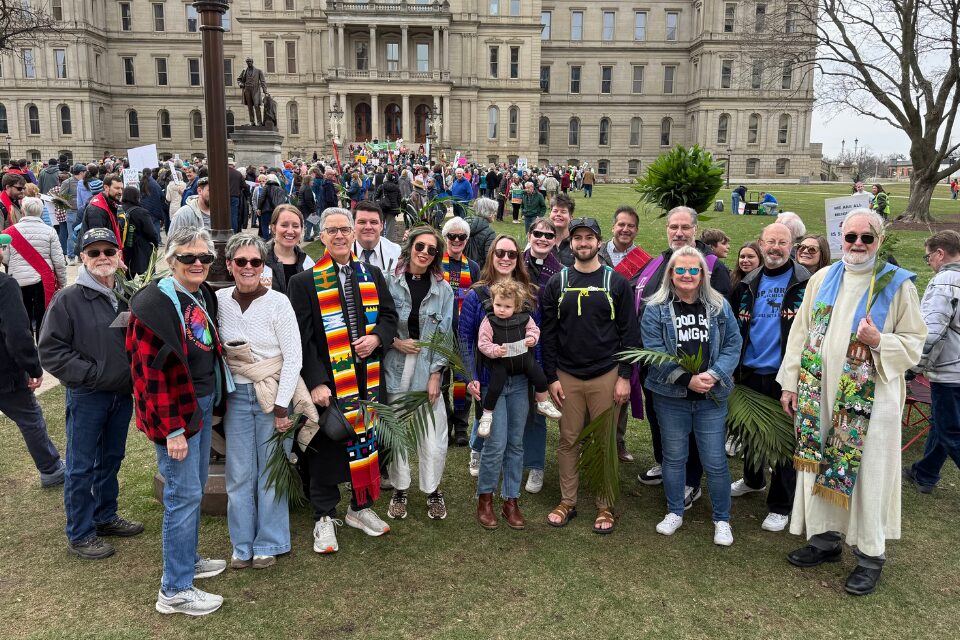
The event’s ecumenical spirit was felt by Rev. Haley Hansen, associate pastor at The Peoples Church of East Lansing. She and Jacob Stone, co-chairs of the Michigan Conference’s Board of Justice, were part of the planning team that included representatives from several mainline Protestant denominations. The Michigan Conference was invited to participate.
“Getting to know people across denominations is always a gift and a blessing,” said Hansen, “and helps us better do the work that God has called us to. I know there are many differences in polity and theology, but honestly, across mainline churches especially, there’s so much that unites us and binds us together.”
Hansen is grateful for the time and ability to strengthen connections with siblings in Christ and put faces to names across Michigan’s mainline churches. It’s this collaborative spirit that we need to press forward together, she says.
She continued, “If we want to be effective in doing justice work, if we really want to help build the kingdom, we have to start working together more. We need to improve our communication. And the Palm Sunday Path is one small way to jumpstart those conversations across denominational lines.”
At the Capitol, the crowd stayed for the entirety of the program featuring a variety of speakers addressing each of the movement’s three core values: feeding the hungry, healing the sick, and welcoming the stranger. The program included prayers, songs, and cries of “Hosanna!” that echoed across the Capitol grounds.
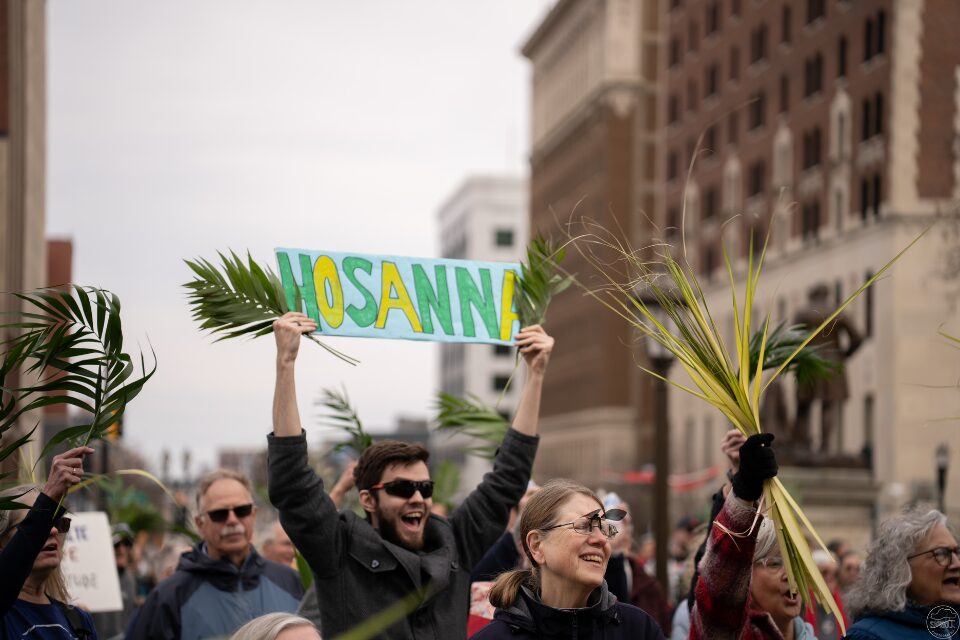
The event, held on Palm Sunday, emphasized Jesus’ kingdom, rooted in love rather than power, as an alternative to the world’s ways that seek to divide and control. On Palm Sunday, Christians remember that Jesus entered Jerusalem with nothing but truth, peace, humility, and an unshakable love for the world.
Unlike the Michigan Conference’s annual Advocacy Day, the event did not include meetings with legislators; instead, it focused on bearing witness and building relationships across denominational lines.
Rev. Hansen observed, “These sorts of events are part of the puzzle of how we do justice work. One rally at the Capitol isn’t going to bring about God’s peace and justice on earth, but it is a chance to get to know other people of faith in Michigan who share similar priorities, hopes, and dreams.”
Bishop David Bard attended the Palm Sunday Path and gave the benediction.
Regarding why the event was meaningful, Bishop Bard said, “The United Methodist Church has a wonderful history of ecumenical cooperation and shared public witness. I see participation in the Palm Sunday Path as one way we seek to live out our love for God and neighbor, do justice, and care for our community, in the spirit of our Social Principles. It is a good companion to our Advocacy Day.”
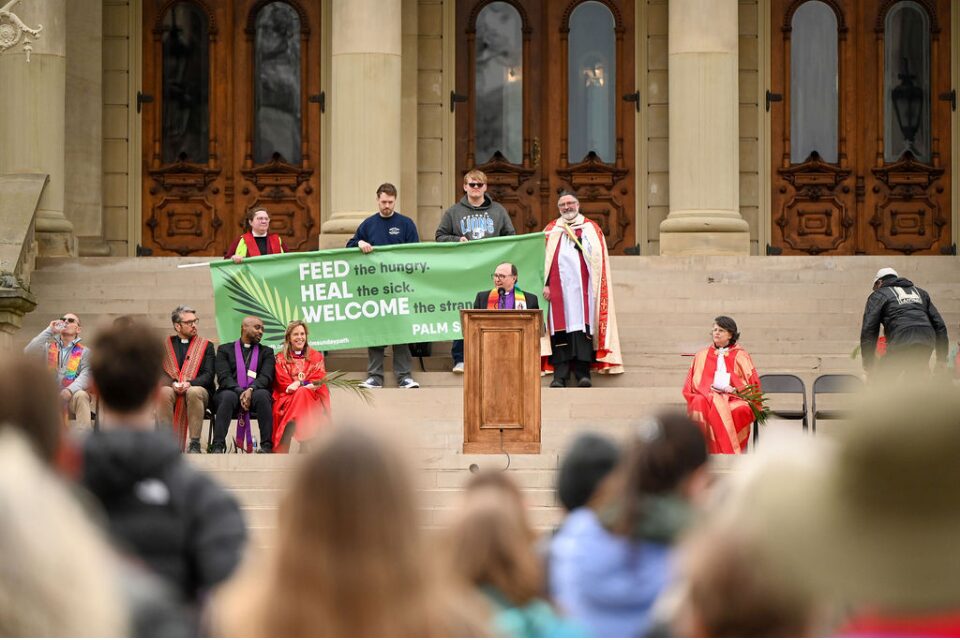
The event closed with a powerful visual act: attendees laid their palm branches on the Capitol steps, a symbol of their presence and their commitment to the well-being of their communities and their state.
Even before the last palm branch was put down, the movement’s next chapter was already underway.
The Palm Sunday Promise, a commitment framework open to anyone in Michigan, whether or not they attended the march, invites people to engage at three levels:
-
- Pray: Commit to regular prayer for the hungry, the sick, and the stranger in your community.
- Learn: Engage with resources to deepen understanding of how these issues affect your county.
- Act: Take concrete steps — volunteer, advocate, show up — in your own community.
Within the first 24 hours, more than 100 people signed the Palm Sunday Promise, with representatives from a third of Michigan’s 83 counties. Organizers said the response signals a desire for faith-rooted community engagement that extends far beyond Lansing.
“This was never meant to be a single event,” said Rev. Canon Nurya Love Parish, Director for Mission and Community Engagement for the Episcopal Diocese of the Great Lakes and a Palm Sunday Path organizer. “The Palm Sunday Promise is how this movement lives in every county in Michigan through people who are ready to pray, learn, and act where they are.”
Palm Sunday Path Michigan is an ecumenical initiative uniting Christians across denominations around the Matthew 25 call to feed the hungry, heal the sick, and welcome the stranger. Learn more and sign the Palm Sunday Promise.
Last Updated on April 6, 2026