
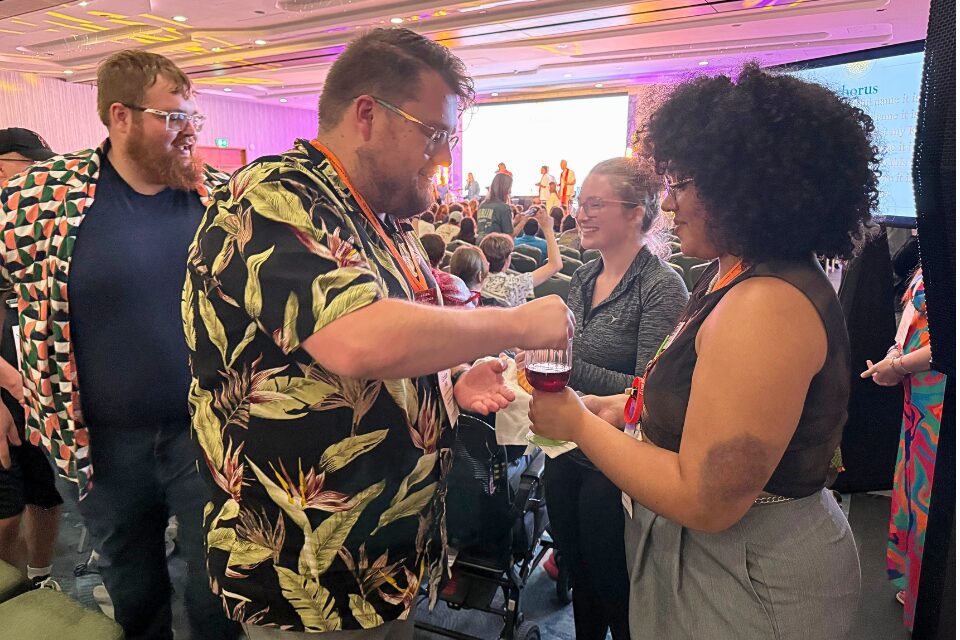
Gordon Grigg, who attended the Global Young People’s Convocation, learned that United Methodist history shows that when we allow young people to lead, transformative change occurs.
GORDON GRIGG
Pastor, Menominee: First and Stephenson UMCs
Saying the Global Young People’s Convocation (GYPC) was a fantastic experience would be an understatement. I am deeply grateful to the members, churches, boards, and agencies of the Michigan Conference whose financial and spiritual investments made it possible for our young people to attend. It was profoundly refreshing to step into a space where young people weren’t the anomaly and to connect with peers from 15 countries across our global United Methodist connection.
Read more reflections from the Michigan Conference delegation to GYPC.
Throughout the convocation, we caught a vibrant glimpse of what God is doing through the worldwide church. I attended several workshops and look forward to sharing these insights with my colleagues across our conference. One standout session was UMC History and Young People’s Movements, led by Dr. Ashley Boggan, who spoke at the 2026 Michigan Annual Conference. We often forget that Methodism began as a radical movement pioneered by teenagers and young adults. During her presentation, Dr. Boggan noted that Methodists are good people who break bad rules.
We see this in William Morgan, a 20-year-old original member of John and Charles Wesley’s “Holy Club,” who insisted that effective ministry required stepping beyond Oxford’s walls to serve those barred from the church due to poverty. They didn’t seek permission; they simply went. This radical commitment to the marginalized is a foundational thread woven throughout our history.
Methodism has always been at its best when it is willing to adapt to a changing world. A prime historical example is “motive” magazine, which emerged from the Methodist Student Movement. It was a publication created by young people, for young people. While they sought wisdom from older experts, young Methodists retained editorial control and boldly tackled pressing social issues of their day, including civil rights, the Vietnam War, and gender equality. Historically, young Methodists have consistently aligned with the marginalized, participating in sit-ins and marching alongside leaders such as Dr. Martin Luther King Jr.
History proves that when we allow young people to lead, transformative change happens. Too often, the church asks, “How do we entertain young people until they are ready to become disciples?” Instead, the question must be, “How do we equip young people for the discipleship they are already living out?” Furthermore, we must move beyond tokenism. Simply placing a young person on a board to check a box is not enough. The church frequently declares that young people are the church of today and tomorrow, yet hesitates to grant them real leadership authority.
While the Michigan Conference has made commendable progress in amplifying youth and young adult voices, there is still work to be done. For context, the Arkansas Conference sent approximately 70 delegates, representing nearly 10% of the entire convocation. Moving forward, my hope is that those of us who attended will collaborate with conference leadership to move beyond empowerment toward true partnership and governance. The church has always changed for the better when young people are allowed to lead.
Youth and young adult attendees of GYPC received partial financial support through grants from the Board of Young People’s Ministries and district grants, made possible by generous financial gifts from local United Methodist churches in Michigan through Ministry Shares. Thank you for investing in our young people! Learn about the impact of Ministry Shares on mission and ministry in Michigan and around the world.
Last Updated on July 20, 2026