Rev. Jeremy Africa continues our Lenten series on aspects of our United Methodist identity and beliefs with some thoughts on the primacy of Scripture in our walk of faith.
REV. JEREMY AFRICA
Midland: First UMC
Editor’s note: This year, the Michigan Conference is focusing on rediscovering what sets us apart as United Methodist Christians. Conference leadership invites every local church to plan a study of Laceye Warner’s “Knowing Who We Are: The Wesleyan Way of Grace.” This book offers a clearer picture of our Wesleyan way of following Jesus. Read this article to learn more.
Like 56% of U.S. adults responding to a Pew Research Center survey in 2024, I identify with the religion I was raised in. For me, this is Christianity. More specifically, I do so as a United Methodist.
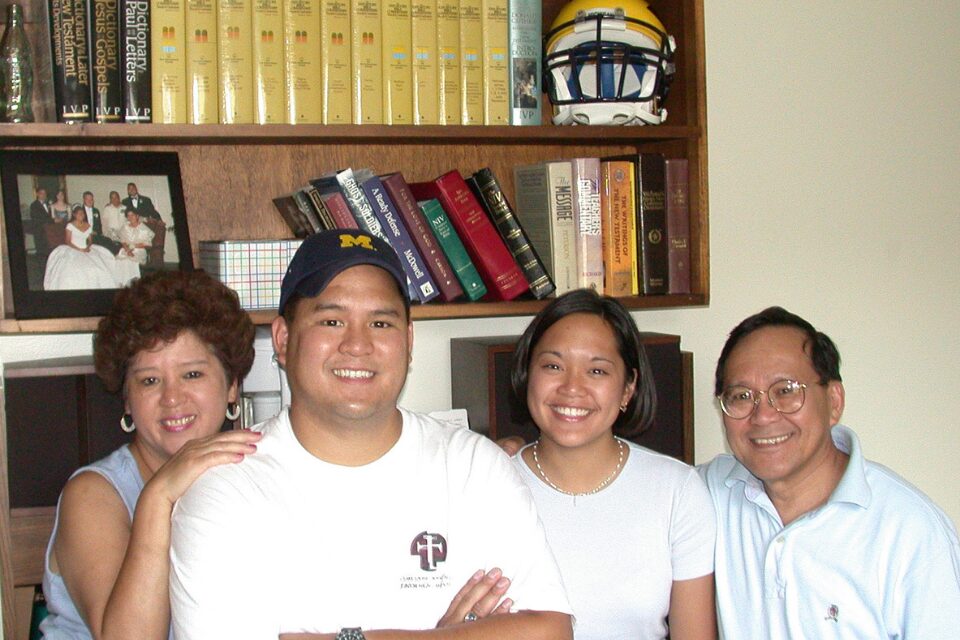
My parents had me baptized at a United Methodist church in Flint. Detroit: Metropolitan UMC nurtured my faith from childhood through college. Summer camps at Lake Louise, Bay Shore, and Judson Collins were pivotal in discerning my call to ministry.
Several United Methodist churches (in Fraser, Utica, and Birmingham) were courageous enough to hire me in my early 20s onto their staff to do youth ministry.
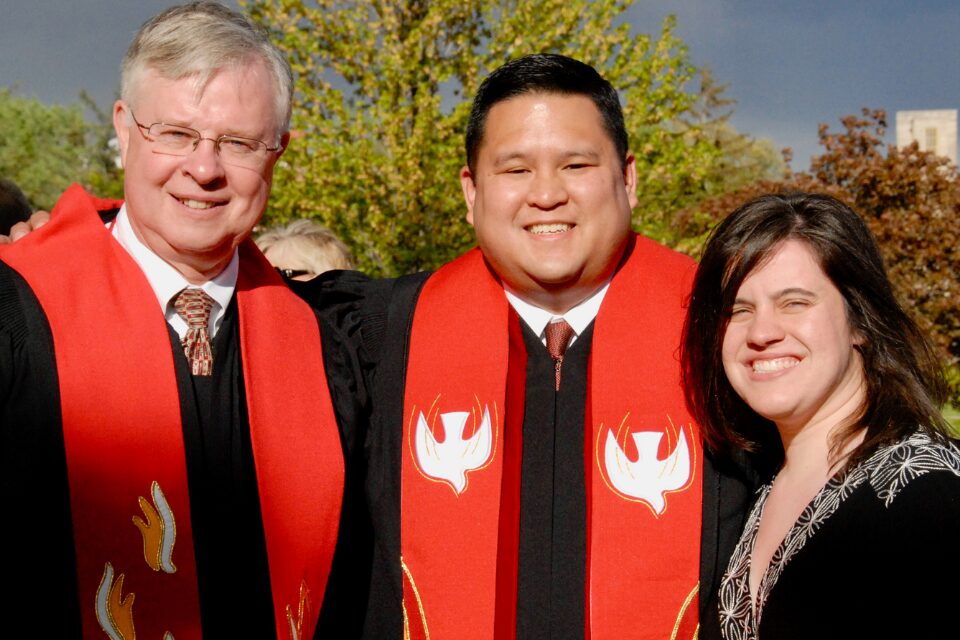
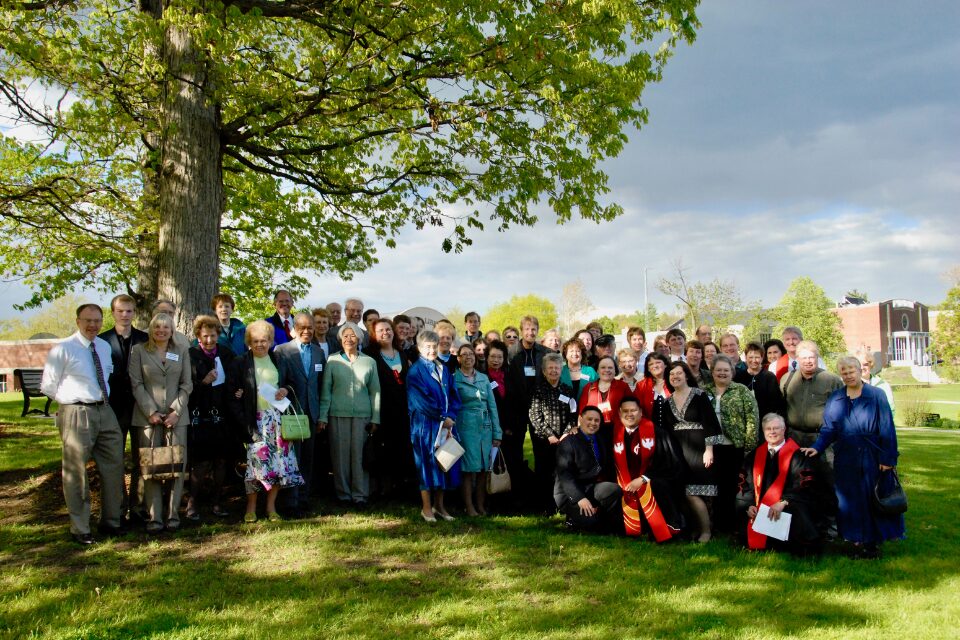
Birmingham: First UMC generously encouraged me as I ventured into being commissioned as an elder in The United Methodist Church. And, it was Midland: First UMC who walked alongside me every step of the way in being ordained.
I am and will always be grateful for the “cloud of witnesses” that has surrounded me along the way, through these points and beyond.
So, it’s funny to think, reflecting on my journey, that it was in an 11′ x 11′ single dorm room in Grice Hall at Asbury Theological Seminary in Wilmore, Kentucky, where I became keenly aware of our uniquely Wesleyan way of reading and interpreting Scripture. Even more surprising is that this insight came from reading the 2000 Book of Discipline as an assignment for my polity class!
Nonetheless, I can still remember my excitement in reading ¶104: “Section 4 – Our Theological Task” (¶105 in today’s copy).
It is in this portion of our discipline that we profess that “United Methodists share with other Christians the conviction that Scripture is the primary source and criterion [emphasis added] for Christian doctrine. Through Scripture the living Christ meets us in the experience of redeeming grace.”
Further on, it states that “the Bible serves both as a source of our faith and as the basic criterion by which the truth and fidelity of any interpretation of faith is measured.”
In other words, rooted in the ways of John Wesley, as United Methodists, we place a distinct emphasis on the Bible as our means of understanding, testing, and living our faith.
Laceye Warner, in her book “Knowing Who We Are: The Wesleyan Way of Grace,” summarizes our understanding and use of Scripture as United Methodists in the following way:
“For Wesleyans and Methodists, Scripture is inspired by God and authoritative in the lives of Christian believers. From Scripture we receive all we need to experience God’s invitation to salvation in Jesus Christ through the Holy Spirit. Methodist doctrine or beliefs are grounded in Scripture. Scripture shapes our understanding of God’s grace for all and teaches us how to grow in God’s grace and holiness and share God’s grace with others” (p. 93).
Indicative of the importance he placed on Scripture, John Wesley wrote in the preface to his first sermons, “God himself has condescended to teach the way . . . . He hath written it down in a book. O give me that book! at any price, give me the book of God! . . . Let me be homo unius libri [a man of one book].”
Even with such a high regard for Scripture, as United Methodists, we recognize that our efforts to be faithful in loving God and our neighbors as ourselves require more. For this, we turn to the resources of tradition, experience, and reason. Or what Albert Outler, a twentieth-century American Methodist theologian, coined the “Wesleyan Quadrilateral.”
With our distinct emphasis on Scripture, United Methodists seek to understand the Bible and our faith through these lenses, continuing to follow in the ways of John Wesley.
By tradition, we are referring to the Church’s understanding of the Christian faith across generations and the centuries. It’s through the collective discernment, wisdom, and practices of the Church that we seek to understand God’s Word.
Furthermore, we turn to experience, our lived-out encounters of God and God’s grace in the world, to inform our reading of Scripture. Warner, in “Knowing Who We Are,” suggests that this experience, which helps us interpret Scripture, is both personal and communal in nature.
Finally, reason in this context is our God-given ability, created in the image of God and empowered by the Holy Spirit, to think critically. We proclaim in that section of the Book of Discipline that I discovered years ago in Grice Hall: “By reason we read and interpret Scripture. By reason we determine whether our Christian witness is clear. By reason we ask questions of faith and seek to understand God’s action and will.” And more.
Yes, this distinctive Wesleyan way of understanding Scripture is one of the many ways we identify as United Methodists. It is also one of the very reasons I continue to be excited to be a United Methodist.
Even so, as many of us can attest, our path has not always been, and is not always, easy. Even with this agreed-upon approach to understanding Scripture, we have our differences. And some of these have led to some of our most hurtful moments as the church.
Whether it’s been when gathered as an annual conference, during conversations in my church office, or when a colleague openly questioned whether there ought to be room for me in the emerging United Methodist Church, I am reminded that our different interpretations of Scripture can lead to substantial and painful disagreements. Perhaps you, too, can recall such times in your journey.
In the end, I am grateful that — with God’s help — I am a United Methodist today.
Because I find that when we put in the hard work of understanding Scripture and what it asks of us, and when we find the courage to explore our differences with others, it is in the nooks and crannies of our diverse traditions, experiences, and reasoning where God shows up the most. And when God appears in these places, I’m finding that God is still giving me (and more importantly, our church!) the opportunity to envision God-sized dreams together for the Church — as United Methodists.
The publication of this article was made possible thanks to generous financial gifts from local United Methodist churches in Michigan through Ministry Shares. Thank you! Learn about the impact of Ministry Shares on mission and ministry in Michigan and around the world.
Last Updated on March 23, 2026