
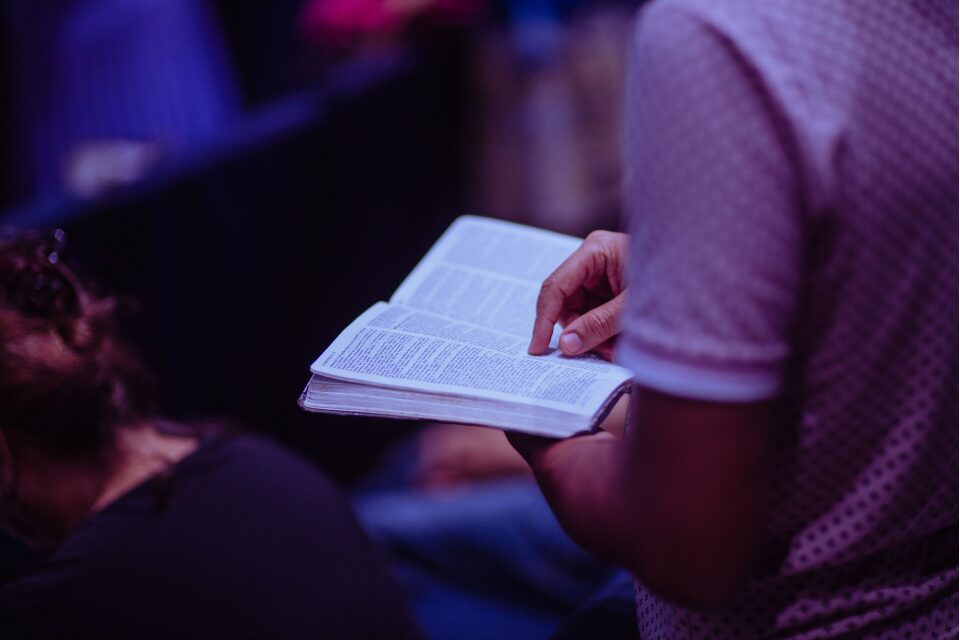
Gordon Schleicher offers an overview of merism, a hallmark of biblical Hebrew that provides a more expansive view of our Creator’s work.
REV. DR. J. GORDON SCHLEICHER
Retired Elder, Michigan Conference
What do you think of when you read or hear “ladies and gentlemen” or “male and female”? I used to think those pairs of words referred to two distinct categories. Now, prepare to think differently.
To date, no other word has opened the world and the Bible for me more than the word “merism.” No, you won’t find the word in your Bible, but you will see merisms throughout it.
Merism is a literary device in which a whole is described by mentioning its contrasting parts — typically two extremes. By naming the “poles” or “boundaries” of a concept, the author intends to include everything in between. A merism is like a bookend; it has two ends and holds everything in between.
Think of it as shorthand for totality. Instead of listing every item in a set, the writer uses a pair of opposites to represent the full spectrum.
Some examples of merisms you have likely used without realizing it:
-
- “Ladies and gentlemen” refers to the entire audience.
- “Sun, sea, and sand” refers to a tropical vacation or the beach experience.
- “Hook, line, and sinker” refers to being completely deceived (using fishing tackle parts).
- “For better or for worse, for richer or for poorer” represents the entirety of life’s circumstances. In marriage vows or similar legal language, many “doubles” are merisms intended to be all-encompassing.
You’ll also find merisms in literature as polar extremes, referring to two opposites to imply everything in between. Examples include:
-
- “I searched high and low.” (Meaning: I searched everywhere.)
- “From cradle to grave.” (Meaning: Throughout an entire life.)
Merism is a hallmark of biblical Hebrew and even Greek. Here are just a few examples:
-
- “The heavens and the earth” (Genesis 1:1) is perhaps the most famous merism in Scripture. It doesn’t just mean the sky and the dirt. It is an expression for the entirety of the created universe.
- “Morning and evening” (Genesis 1:5) equals a full day.
- “From the rising of the sun to its setting” (Psalm 113:3) refers to all places on earth (east to west) and all times of day.
- “My sitting down and my rising up” (Psalm 139:2). The psalmist isn’t just interested in two specific physical movements. This merism encompasses every activity of the person’s life throughout the day.
- “If I ascend to heaven . . . if I make my bed in Sheol.” This contrast between the highest and lowest points indicates that God is present everywhere. There is no corner of existence where God is not.
- “Alpha and Omega” (Revelation 20:13) uses the first and last letters of the Greek alphabet to describe God’s sovereignty over all time — the beginning, the end, and everything in between.
Now consider from Scripture that after God created the Human, God took a rib from the Human and created a woman. As a merism, “male and female” includes the full spectrum of humanity created in God’s image. After God created the male and female, God declared them good. That would mean that “male and female” are not binary but bookends that encompass all human life in between. And when God finished, God declared them good.
“Whoever Heard of a Merism? (God’s Expansive Creation)” explains that God created humans in all colors, genders, abilities, ages, and shapes, and found them good. Given the diversity God created, God must delight in it. Shouldn’t we as well?
—
For further study:
A Merism of God: A deeper dive into the definition of a merism — where naming extremes stands for the whole — and how God utilizes this device throughout Scripture.
Part 4 Quick Clip — Dr. Wave Nunnally: Dr. Nunnally provides a concise explanation of the merism as a literary device and why identifying it is helpful for accurate biblical interpretation.
What Rhetorical Devices Can Word Study Uncover in the Bible?: This video covers various rhetorical devices found in the original languages of the Bible, including how word studies can reveal merisms that might be missed in a surface-level reading.
The publication of this article was made possible thanks to generous financial gifts from local United Methodist churches in Michigan through Ministry Shares. Thank you! Learn about the impact of Ministry Shares on mission and ministry in Michigan and around the world.
Last Updated on August 26, 2026