
After a summer of camping across Michigan, retired pastor Sondra Willobee discovers the most beautiful sight of all on the side of a busy freeway.
SONDRA WILLOBEE
Retired Pastor, Michigan Conference
“But a Samaritan while traveling came upon him, and when he saw him he was moved with compassion” (Luke 10:35, NRSVUE).
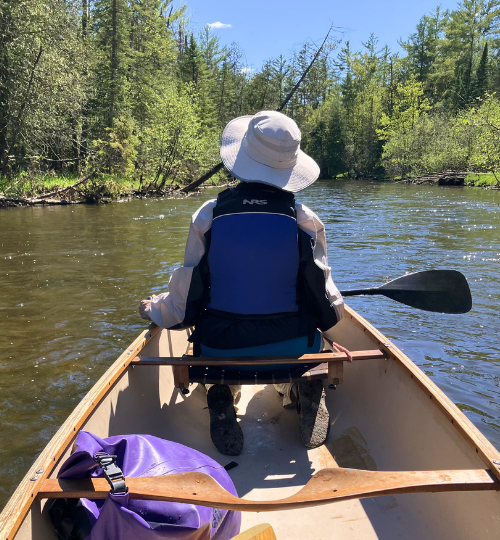
Our summer of fun included seven — count ’em, seven — camping trips. Canoes lashed to the roof of the Subaru, bikes strapped to the back of the Palomini travel trailer, time after time Ed, my husband, and I pulled out of the driveway to enjoy the glories of summer in our beloved state.
In April, we headed to nearby Bruin Lake for a spring shakedown cruise. We surprised a beaver at twilight and discovered trillium nestled among skunk cabbage along a small creek. In May, at the Rifle River Recreation Area, we scrambled over log jams in the river. Lured by the call of a loon on Grebe Lake, we were stunned at sunset by a whole hillside of yellow lady slippers.
June found us in the Thumb. We camped at Sleeper State Park on Lake Huron and toured natural and historic sites with our nephew, an amateur local historian who discovered a pre-settler quarry where Native Americans chiseled chert into scraping tools. At the Old Bay Port Cemetery, I traced the letters on the headstone of my great-grandfather, Andrew J. Bradd (1861-1955), who worked the settler quarry adjacent to the Native one.
At Bowman Bridge National Forest Campground in July, we had the Pere Marquette River to ourselves where we herded mergansers downriver during the day and plunged into the fifty-five-degree river to cool down at night. Hemlocks hung over the water, and magnificent white pines towered over bluffs. “Why don’t we come here more often?” Ed asked. Later in the month, from Canoe Harbor Campground, we plied the “holy water” of the AuSable with our paddling club.
August brought sun and sand with family along Lake Michigan. Camping at Hoffmaster State Park, we enjoyed a perfect beach day with all four grandkids, constructing sand castles, eating popcorn, and body surfing in two-foot waves. Five-year-old Dexter plunged his face into the waves over and over, laughing with joy.
At Interlochen State Park, we woke to the sound of marching bands on the practice field, then drove west to canoe on the Platte River among the dunes and to watch our grandkids run headlong down sandy hills into the water.
It was wonderful.
Our adventures weren’t without risks or dangers, though. We could have flipped in the tricky cross-currents around the bends of the Pere Marquette, and gotten tangled in the tag alders that line the banks. We could have gotten Lyme Disease from ticks that might have hidden themselves in the zippers of our tear-off hiking pants. (They didn’t, and we didn’t.)
A tree could have fallen on our trailer, as it did to campers in site #356 at Interlochen when a severe thunderstorm came through one night. Fortunately, no one was hurt, and only an awning had to be replaced.
Yet, the biggest danger during our summer of fun was not in the woods or on the water.
It was on the road.
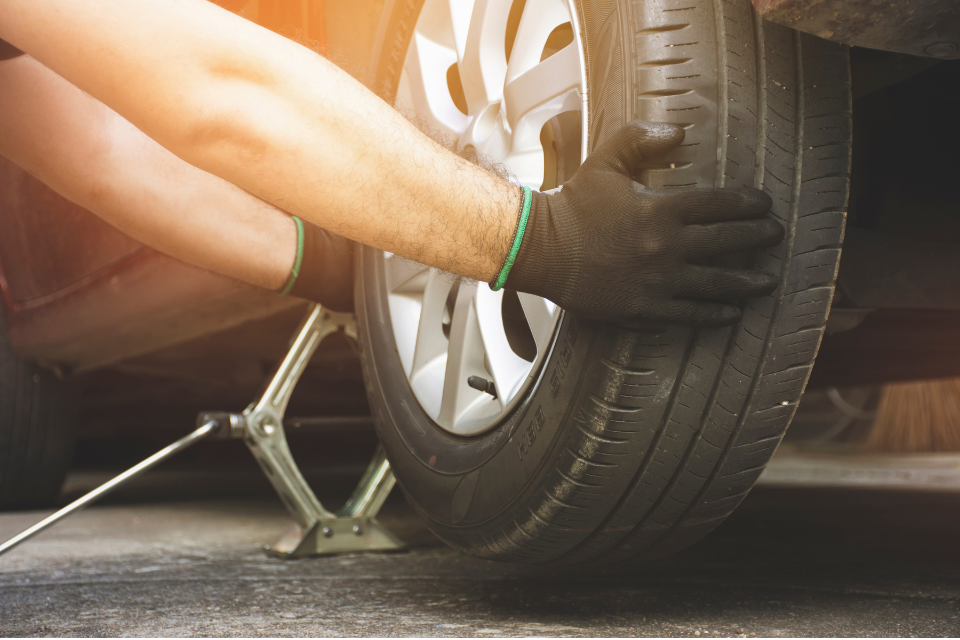
At the end of our final camping trip, when we were driving east on I-96 just twenty-five minutes from home, we blew a tire on the freeway side of the trailer. The tire’s explosion rocked the car. Ed pulled quickly onto the gravel shoulder. I jumped out to drag an orange barrel out of the way — of course there were orange barrels, it’s Michigan — so Ed could move the car and trailer farther off the freeway. Semis and double-haulers thundered by while passenger vehicles jockeyed for position to get out of the way.
I felt small and vulnerable.
Ed got the power drill out of the trailer boot to raise the trailer jacks. After raising the trailer, he got out the four-way lug wrench to unscrew the lug nuts on the spare and on the blown tire. I did what I could, pocketing the lug nuts from the spare for safekeeping and spreading the tire cover on the back seat so the blown tire didn’t damage the upholstery.
The sun shone hot, and the noise of nearby traffic filled our ears. We had to shout to be heard.
As Ed began loosening the lugs on the blown tire, I saw a white pickup truck with ladders on the roof backing toward us on the shoulder. A dark-haired, olive-skinned young man got out quickly and opened the truck cap. He shrugged on a fluorescent yellow vest and pulled a larger four-way from under the seat.
He came over and knelt beside Ed, asking if he could help. Ed said he was okay, but the young man insisted. Though his accent revealed that English was not his first language, his meaning was clear. Ed let him proceed. The young man removed the remaining lugs and slid the spare into place.
I watched for a few minutes, then moved to the back side of the trailer away from the traffic. Ed told me later that when he remained to watch the young man work, the young man told Ed to join me on the back side of the trailer. “Go behind, go behind,” he said. After the spare was mounted and the lugs tightened, the young man picked up his four-way and stood. Ed took out his wallet to thank him. The young man shook his head back and forth vigorously. “God has paid me,” he said.
When we set out on our summer of fun, I expected to see many beautiful sights. I looked for them deep in old-growth forests, along the banks of clear-running rivers, and high on a dune overlooking a vast expanse of blue water. And I found them.
But I never expected the most beautiful sight we would see to be on the hot gravel shoulder of I-96, with traffic screaming by. Where a young man who spoke in accented English motioned for my husband to go behind the trailer and to put his wallet away.
One of the most famous stories Jesus told is the parable of the Good Samaritan. In that story, a man traveling from Jerusalem to Jericho was set upon by robbers, stripped, beaten, and left half dead. Two different religious leaders passed by and did nothing. The person who stopped to help was a Samaritan. In Jesus’ time, “Good” and “Samaritan” didn’t go together. Jewish purists shunned Samaritans, viewing them as religious heretics and ethnic half-breeds. Though both Jews and Samaritans were descended from ancient Israel, there was a long-standing hostility between them.
If human behavior then was anything like it is now, some religious and political leaders would have fanned the populace’s hostility toward these “others” to enhance their own power.
Yet, in Jesus’ story, it was the Samaritan who bandaged the injured man’s wounds, placed him on his own donkey, brought him to an inn, took care of him all night, and left money with the innkeeper to take care of him until he returned.
That day beside I-96, Ed and I were like the injured man in Jesus’ story. We received life-saving kindness in the name of God from someone we’ve been told to fear or despise.
I don’t know whether the young man was a Muslim or a Lebanese Christian. Or some other faith. Many immigrants of various faiths live and work in Michigan.
It doesn’t matter.
God is praised.
The Rev. Sondra Willobee is a retired elder, last serving as lead pastor at South Lyon: First UMC. She wrote articles for The Michigan Christian Advocate, FaithLink, and Linktionary, and is the author of The Write Stuff: Crafting Sermons That Capture and Convince (2009). You can also read her blog, sondrawillobee.com/blog.
The publication of this article was made possible thanks to generous financial gifts from local United Methodist churches in Michigan through Ministry Shares. Thank you! Learn about the impact of Ministry Shares on mission and ministry in Michigan and around the world.
Last Updated on September 28, 2026