
Continuing our “America at 250” series of op-eds, Joy Moore speaks to the primacy of our allegiance to God above all earthly empires and lords and explains why this matters for faith.
REV. DR. JOY J. MOORE
Elder, Michigan Conference
Editor’s note: This is the fifth in a series of occasional articles on our nation’s 250th anniversary. Several voices from across the Michigan Conference will address different topics and speak to this question: “What is the Wesleyan way to be patriotic in this moment?” Read the whole series.
I like to say I was born into a gap in history: a strange, brief window when women were preaching from pulpits that had long excluded them, when the gospel still had something like a shared center, and when a gathering of Christians could look like a rehearsal of the kingdom of God rather than a chapter of a political party.
That gap has been closing for a long time. I feel it whenever someone walks out of a Bible study because of how a neighbor voted. I see it when a congregation cares more about the placement of a flag than about the place of a stranger. I hear it when a Christian suggests that loving country and loving God have become the same commandment. Our failure to confront this plainly, from the pulpit and in public, is one of the most urgent pastoral problems of our time.
“One cannot see the modern world as it is unless one recognizes the overwhelming strength of patriotism, national loyalty,” George Orwell wrote in 1941. He continued: “Christianity and international Socialism are as weak as straw in comparison with it.” Hitler and Mussolini rose, Orwell argued, because they understood this fact and their opponents did not.
Not much has changed.
It is easy to imagine this as someone else’s temptation — a problem belonging to a particular party, news channel, or kind of church. It is not. Whether we have been discipled by Jim Wallis or Jerry Falwell, we have too often reduced Christianity to moral imperatives, therapeutic remedies, and utilitarian principles rather than to a witness to the Triune God who is setting the world right.
We are not the first generation to fail this test.
Israel’s elders once came to Samuel with a request dressed as a compliment. Samuel was old, they said, and his sons were unfit to lead. They turned the bench into a business, taking bribes and perverting justice. So the elders asked for a king. Their request sounded reasonable, but in truth, it was a rejection — not merely of their present leaders, but of their covenant-making God.
With God’s own word, Samuel warned the people plainly what a king would cost them: sons constantly at war, daughters disenfranchised, their land confiscated, their produce taxed, and, when the burden finally became unbearable, God’s silence. The people did not care. “No!” they said. They wanted to be like the other nations. God gave them what they asked for, and history changed.
That story is not an artifact. It is a mirror, and American Christians have stood before it for a long time without recognizing their own faces. (As noted above, America is not the only nation to do so.)
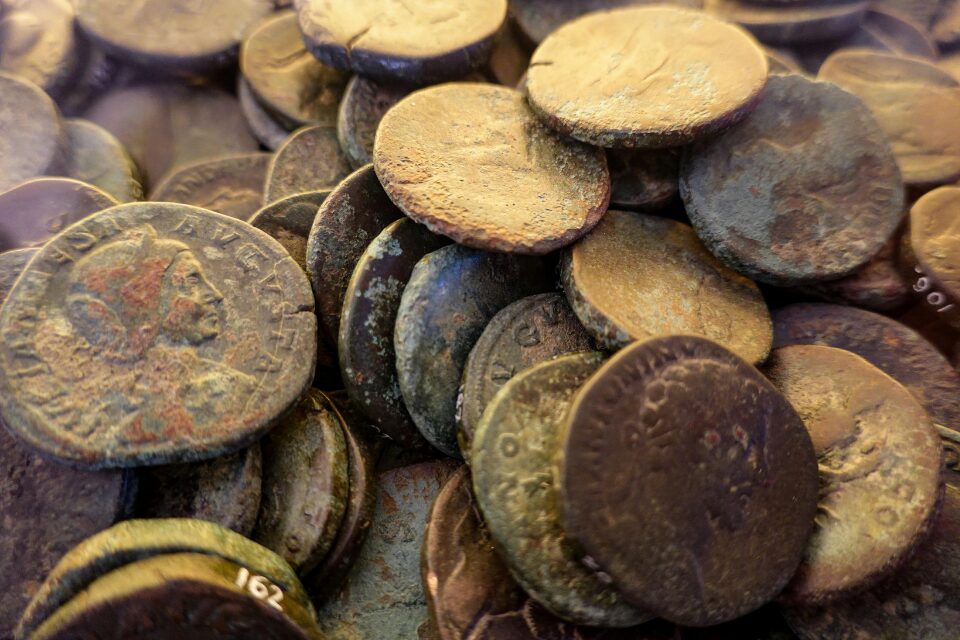
Every era of the church falls into the same trap, dressed in new clothing. Jesus was handed a coin and a question meant to put him in a corner. His answer was not a tidy division of life into separate religious and political lanes. Instead, he asked whose image was stamped on the coin and, by implication, whose image was stamped on us.
Caesar may keep the idolatrous metal bearing his name. God has already created the icon of the Creator. Not statues, towers, temples, or nations. The heavens declare the glory of God, yet God created humanity to bear the divine image.
Paul could tell the church in Rome to submit to governing authorities while reminding the Philippians that “our citizenship is in heaven” (3:30, NIV) because civil order and ultimate allegiance are not the same. Collapsing them is how empires survive.
Exiled on Patmos under an empire that called its ruler “Lord and God,” John heard heaven sing, “Worthy is the Lamb” (Revelation 5). He was not merely drawing a prophecy chart. He was teaching a frightened, occupied church to worship in a way that rejected the empire’s liturgy. To sing “Worthy is the Lamb” is also to declare: Caesar is not worthy.
That is the wager of the New Testament: there are two cities and two lords, and the church’s first citizenship is not negotiable. Dietrich Bonhoeffer understood this when he refused to allow the German church to become the Third Reich’s chaplain. Corrie ten Boom’s family practiced it by creating a hiding place. Martin Luther King, Jr., proclaimed it from a Birmingham jail, warning that the church’s silence in the face of injustice was itself an act of allegiance. None of them was anti-national. Each simply refused to let their nation stand where only God belongs.
What, then, does allegiance look like if not a flag on the altar or a donkey or an elephant substituted for the cross?
It looks like a people who can be politically visible without being politically owned. A people who enter public life as citizens of God’s kingdom first, refusing both chaplaincy to the state and the comfort of withdrawal. It looks like dissident disciples who are not merely against something but for a kingdom whose economy is mercy, whose citizenship crosses borders, and whose King rode a donkey before being crucified by an empire unable to distinguish order from idolatry.
Every Sunday, in sanctuaries around the world, we still sing, or we should, “Worthy is the Lamb.” Not Caesar. Not the donkey or the elephant. Not the flag, folded so carefully that it begins to resemble an altar cloth.
Worthy is the Lamb who was slain.
That is not a bumper-sticker slogan. It is the church’s oldest and most dangerous confession, and it is past time we meant it again.
Caesar is not worthy, whatever his party. Babylon is not worthy, even when dressed as our hometown.
Worthy — only, finally, and unapologetically — is the Lamb.
Rev. Dr. Joy J. Moore serves as Theologian in Residence and Professor of Theology and Biblical Interpretation at Friends University in Wichita, Kansas. She is an ordained elder and member of the Michigan Conference of The United Methodist Church.
The publication of this article was made possible thanks to generous financial gifts from local United Methodist churches in Michigan through Ministry Shares. Thank you! Learn about the impact of Ministry Shares on mission and ministry in Michigan and around the world.
Last Updated on August 17, 2026