
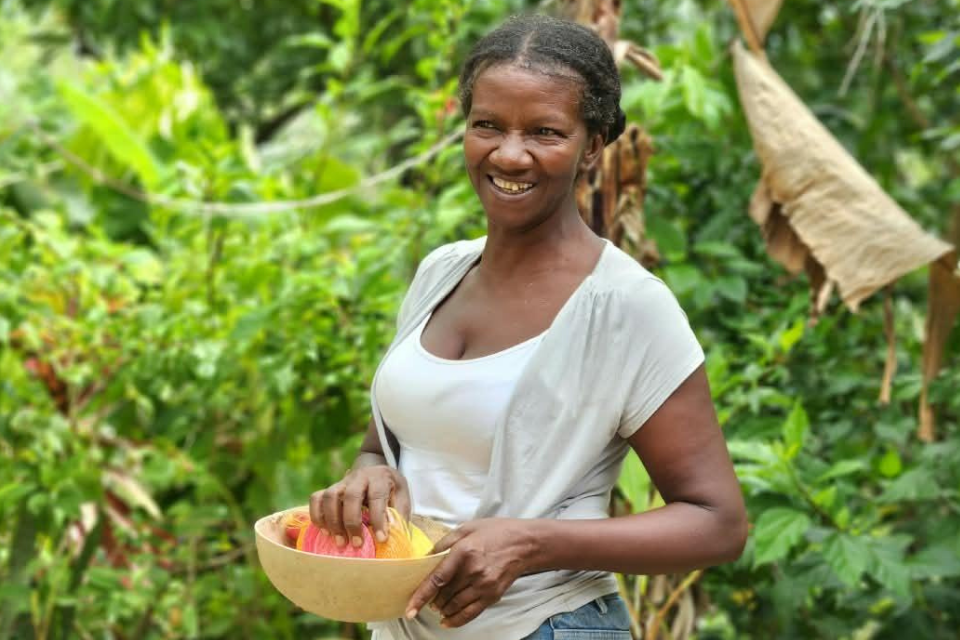
The Gardens of Hope campaign of the Michigan Conference is planting seeds of hope in Haiti with initiatives like MUSO (mutual solidarity groups). Twenty groups are now functioning in Mizak and Jérémie based on the principle, “Service with others.”
KAY DEMOSS
Michigan Conference Communications
In the United States, we call it “the American dream.” But is that not the dream of each person everywhere to be able to have enough to eat, a house to live in, health, education, and an overall sense of security and wellbeing? Is that not the vision of God’s Kingdom that Jesus talked about?
The people of Haiti dream dreams. Blandine Charles lives in Mizak, Haiti. She says, “Thanks to the support of [MUSO], I was able to transform my dream of becoming an entrepreneur into reality.” She is one of many whose lives the Michigan Conference’s Gardens of Hope campaign has touched.
Launched at the 2025 Annual Conference, Gardens of Hope seeks to raise $200,000 to support four ministries with God’s people in Haiti. Three of those ministries are familiar: Haitian Assets for Peace International (HAPI), Jérémie Rising, and Grace Children’s Hospital. The fourth ministry, MUSO, is a new partner with the Haiti Task Force.
Circle of Empowerment
MUSO, meaning “mutual solidarity,” is a strategy born in Africa that is now being developed by Haitians for Haitians. Its parent organization, Grassroots Community Voices Foundation, works in health, sanitation, disaster recovery, and economic development. Josué André is the chairman of the foundation’s board of directors. He was born in Jacmel in southern Haiti.
To date, Michigan congregations have given $125,000 to Gardens of Hope. Most of these dollars have been distributed to the four partners in Haiti. The Haiti Task Force recently received a report from MUSO celebrating the training and transformation underway in Mizak and Jérémie.
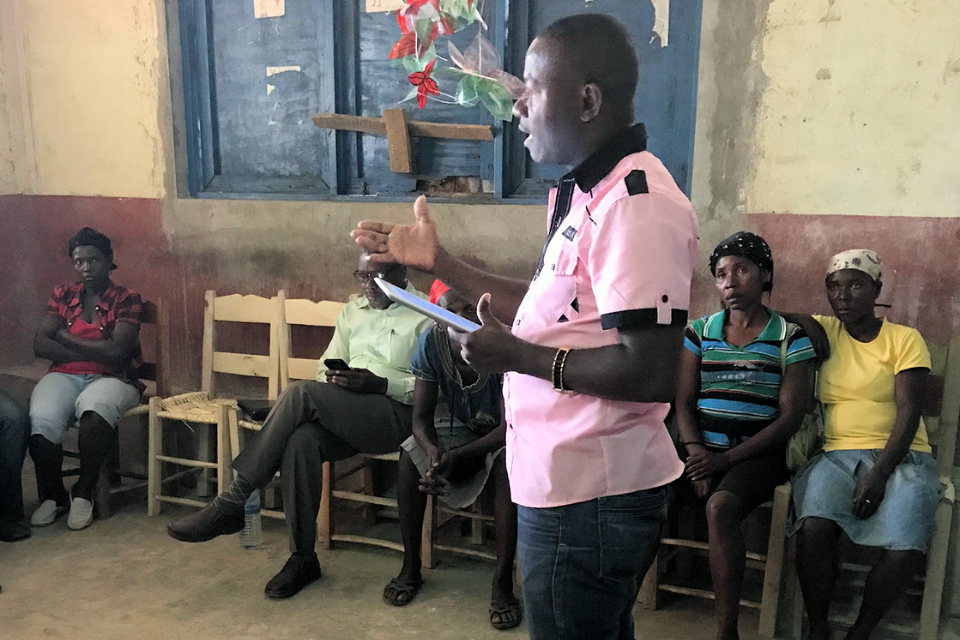
Twenty groups have been established — ten in Mizak and another 10 in Jérémie. Each group has 25 to 30 participants, for a total of 500 to 600 active members. The Gardens of Hope funding paid for the training and materials. A Rotary E-Club of Engagement is also partnering in this effort.
The Michigan Conference’s one-time investment in training and materials for 20 MUSO groups continues to multiply its impact. These groups not only sustain themselves through members’ savings and lending activities, but group leaders can also become trainers, helping establish new groups without requiring additional outside funding. In this way, a single campaign investment creates a ripple effect of economic opportunity, local leadership, and lasting community empowerment.
Participants told trainers what holds them back. They cited too little capital to start an activity, weak access to markets, limited business experience, and household hardship. The training addresses such needs, covering topics like entrepreneurship, money management, and MUSO business practices.
MUSO savings and credit groups are comprised mostly of women. Members buy shares weekly, lend to one another at very low interest rates, and keep funds to grant for emergencies. Grassroots Community Voices Foundation provides training and makes monthly visits to each group to check boxes and report on savings, loans, and repayments.
Each group utilizes a system of three boxes. This method keeps momentum going:
-
- Green Banking Boxes: participants put in weekly shares, loan repayments, and interest. This is the capital members lend to one another. As of September 30, the collective loan portfolio within the Green Boxes has reached $23,388. Loans totaling $4,295 have been made to members in August alone.
- Red Solidarity Boxes: Fees placed in this box help members in hard times of illness, accidents, funerals, or weddings. $1,357 is available.
- Blue Donations Boxes: outside contributions that add to the group’s capital for collective enterprise or community projects determined by the group. Recently, Grassroots Community Voices Foundation received an $8,000 ‘blue box’ donation and is requesting a matching Rotary grant. The funds would be put to work in all 20 groups, funding collective group enterprise such as chicken-raising or sandal production.
MUSO says these numbers reflect, “Members putting their new savings to work.” Valerie Mossman-Celestin, chair of the Michigan Haiti Task Force, shares her excitement over this report. “Some doubted this approach, thinking people who cannot afford food cannot afford to save.” Valerie, married to a Haitian, recalls her husband’s memory of how his mother always put something aside for emergencies, even when it meant less food on the table. “I have known moms who stayed in a church and fasted for 40 days and used that money to put their child through school,” Valerie recalls.
Voices of Hope
Participants in the program are also excited. Marie Marthe Pierre Louis, a trader, says, “[In MUSO] people understand me and support me as if I were their own family. Thanks to MUSO, my child is no longer sent home from school for unpaid fees.” Life is more comfortable now for Marie, who remembers, “Credit used to be hard to find; today it is within my reach. I get credit for my trade, and I can pay for school.”
“When MUSO came to my community, it bore real fruit,” says Michelet Celestin. “Everyone here wants to join, but a MUSO can only have 30 members. We’ve had to turn people away. We could form three more groups.” She is also grateful for how MUSO supports education. “Since the new school opened, parents come to MUSO to borrow for school fees, because 3% is nothing compared to other lenders.” She is now in a cycle of success: “I borrow, I repay, and borrow again to keep my business going.”
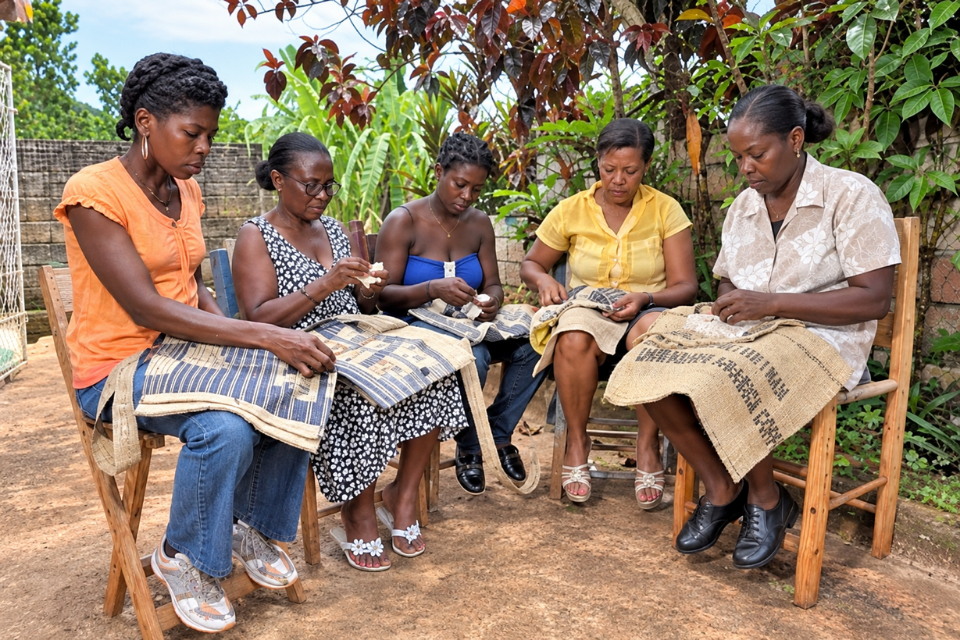
Artisan Jacqueline Celestin belongs to a MUSO group whose members call themselves “My credit, My relief.” She explains, “We get credit without a pile of paperwork, because we learned to trust one another.” She says she and her neighbors did not understand MUSO at first. “But through the training we saw it was the best tool we could have. To grow my craft, I used to borrow from banks, and it never worked out for me. The interest ended up higher than the loan itself.” Jacqueline says, “Hats off to the trainers for their patience and advice.”
“I wanted to start a business selling clothes, shoes, and sneakers,” Blandine Charles remarks. “But I didn’t have the capital. [Through MUSO] I received two loans to buy stock and grow my business. Now I serve my customers better, earn more, and support my family with more dignity.” MUSO is about more than money. “I have more confidence in myself and more hope for the future,” Blandine shares.
Josué André expresses his gratitude. “Thank you to the Michigan Conference and the Rotary E-Club of Engagement for standing with the families of Mizak and Jérémie, in the spirit of ‘Service above Self.’”
Nicole’s Story
Some of the MUSO members in Mizak are former artisans active in Haitian Assets for Peace International (HAPI). Nicole Phitrion is 62 years old. She says that MUSO is “changing my life.”
“I have been an artisan for more than 41 years. I make embroidered pieces, placemats, baskets, bags, and other products using natural materials such as straw and palm leaves,” Nicole recounts. She learned this craft from her aunt. Nicole’s skill has “helped me build my life. My handmade products provide for my home, feed my three children, and pay for their education.”
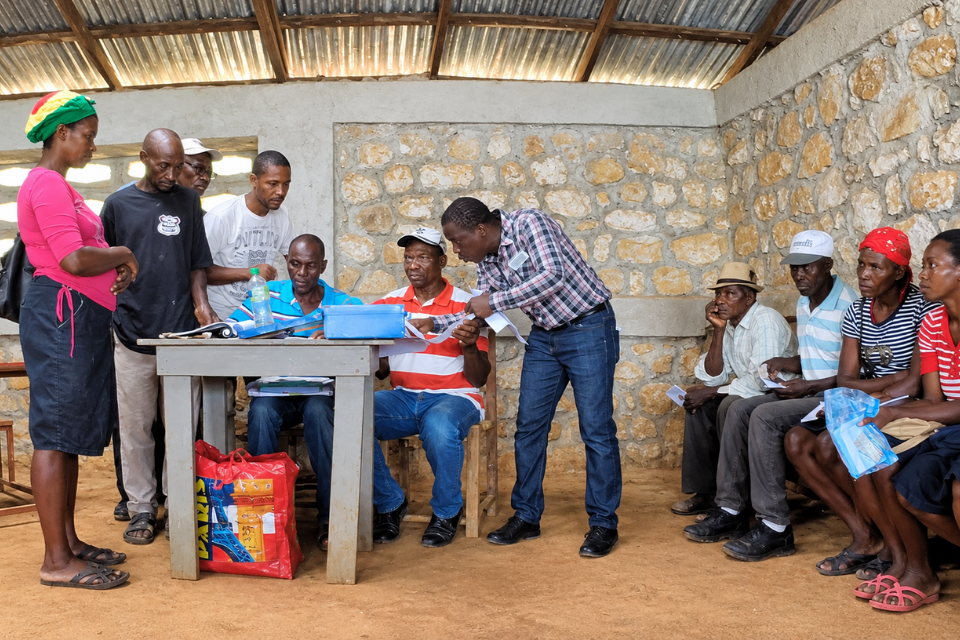
She has made the money earned from crafts work for her. “After paying the people who help me, I use some of my income to buy goats, chickens, and food for them. When the animals reproduce, I sell the offspring and eggs. I later bought pigs and used the manure to support my garden. Little by little, the income from my crafts has allowed me to invest in other activities and create additional sources of income.”
Though she sees her creativity as “a gift from God,” Nicole’s enterprise was limited because she had no access to the financing she needed. That changed when she visited HAPI earlier this year and met the MUSO representative. Mr. Zenny explained how the program brings people in the community together to save money, create projects, and lend money to one another.
Today, Nicole is the president of a MUSO group in her community. She says, “MUSO has made it possible for people to access money when they might otherwise struggle to find it. For example, someone who needs money to send a child to school can borrow from the group instead of waiting until they have enough money or turning to a bank.” MUSO’s low interest rates make it possible for more people to participate and benefit.
Thanks to MUSO, Nicole has been able to expand her small business. “I once borrowed money to buy cocoa to make chocolate. I have also used MUSO financing to buy straw and other raw materials in larger quantities for my craft business, something I could not always afford to do with the money I had available.”
While MUSO is a savings group, Nicole and her neighbors see it as much more. “It is an opportunity. It gives people a way to save, access money when they need it, and invest in their ideas without having to leave their community.” Nicole is grateful MUSO has been organized in Mizak as an opportunity to “build together.”
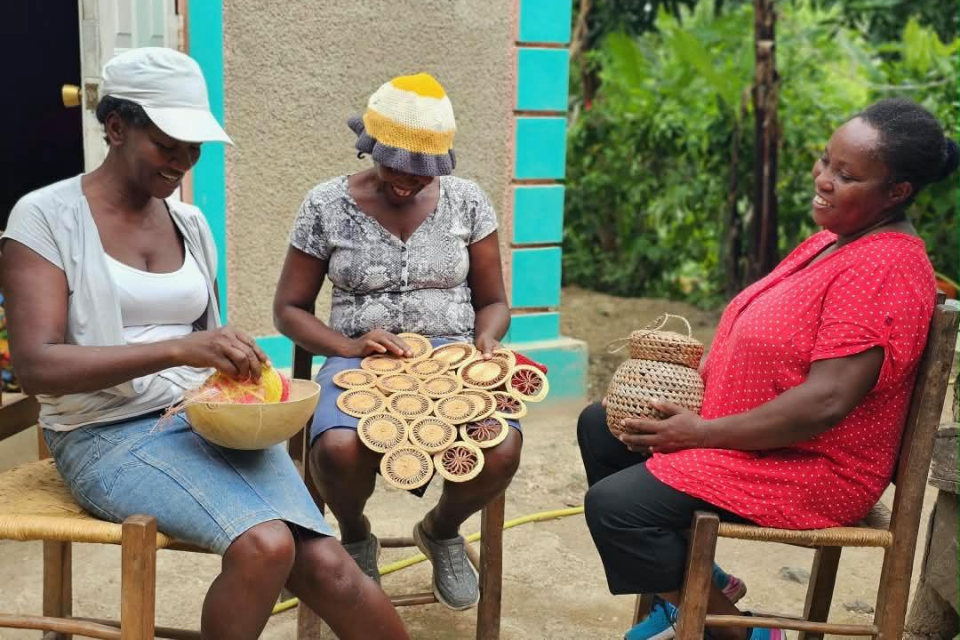
Valerie, U.S. Executive Director of HAPI and chair of the Haiti Task Force, says, “Nicole is my hero.” Valerie remembers meeting Nicole as she became a HAPI artisan. “Nicole has 2 years of education. She started her business with 3 goudes: less than one dime. She became a HAPI artisan, in spite of the two-hour walk.”
Nicole’s three children attended private school. All have graduated. She considers her children her savings investment.
“My favorite part of Nicole’s story,” Valerie says, “is that no one in her community calls her ‘Nicole’ anymore: they call her ‘Mom,’ because she has helped so many community children through her business.
Gardens Campaign Continues
The 2026 Michigan Annual Conference extended the Gardens of Hope campaign through May 2027. Contributions will continue to fund and expand the work of our partner ministries in Haiti.
Valerie describes the bigger stage that provides context for this effort. “The distance between our local neighbor and our global neighbor has never been shorter. Today, as Haitians in the United States face deportation and some are being returned to a country experiencing profound insecurity, that connection has become even more visible. Someone who is our local neighbor today may become our global neighbor tomorrow.”
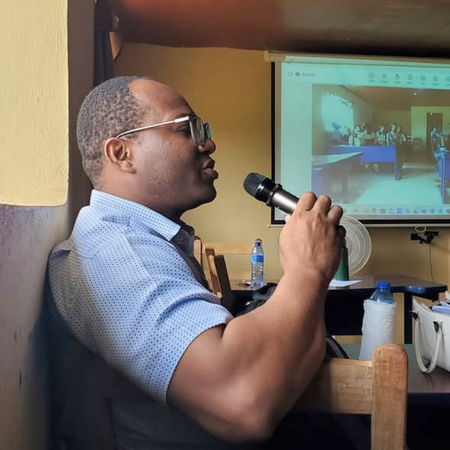
She continues, “Mizak is not simply over there. Jérémie is not simply over there. The road between Michigan and Haiti runs through families, churches, workplaces, hospitals, schools, and communities.”
Supporting the Gardens of Hope campaign is a way to share God’s love with our neighbors in Christ. “We do not walk alongside our brothers and sisters in Haiti because we arrive carrying Christ to them. We walk alongside one another expecting to discover that Christ is already there,” Valerie asserts. “Christ is there in Blandine and her neighbors — Marie, Michelet, Nicole, and Jacqueline — pooling their own resources.”
The Gardens of Hope campaign strengthens long-established ministries with deep-rooted relationships to Michigan congregations. Valerie adds, “I am grateful to Gardens of Hope for cultivating this new partnership with Grassroots Community Voices Foundation. We were aligned in our belief in community-led approaches, but the campaign made it possible for the partnership to grow roots, like a pumpkin vine!” (Note: For Haitians, pumpkins symbolize freedom and resilience. French colonizers considered pumpkins a delicacy, but they were forbidden fruit for those they enslaved. After independence, eating pumpkins became a liberating and empowering act for Haitians.)
Josué André is grateful for the Michigan Conference’s continued belief in community-led approaches. He concludes, “Communities are rich in strengths, compassion, and resilience, even when resources are scarce. [These stories of success] are powerful reminders of the enduring connections that come from walking alongside communities with compassion and hope.”
The Kingdom of God is more than a dream. It is a future and a present reality.
Valerie says of her friend in Mizak, “Nicole Phitrion told me some people say to her that ‘Jesus is coming,’ but they don’t know how or when. But for Nicole, as she looks at how her life has changed, she feels that ‘God is walking on the ground’ with her, in the here and now.”
In Haiti today, MUSO is one answer to our prayer, “Thy Kingdom come.”
Give now to the Gardens of Hope campaign.
The promotion of the Gardens of Hope campaign and the publication of this article are made possible thanks to generous financial gifts from local United Methodist churches in Michigan through Ministry Shares. Thank you! Learn about the impact of Ministry Shares on mission and ministry in Michigan and around the world.
Last Updated on October 20, 2026