
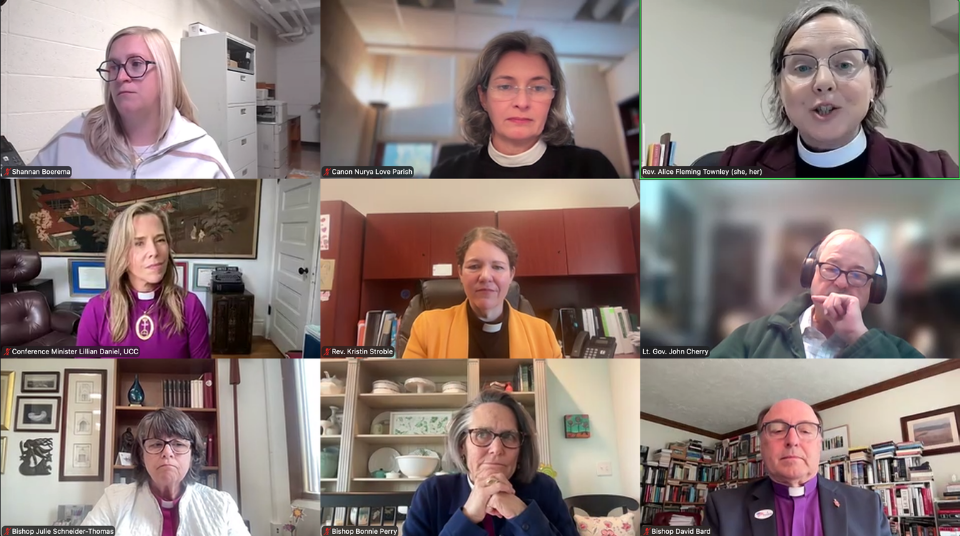
At a Tuesday news conference, leaders from five Michigan denominations, including Bishop David Bard, urged voters to cast ballots with confidence and treat one another with love, however they vote.
MARK DOYAL
DIRECTOR OF COMMUNICATIONS
LANSING, Mich. — One week before Election Day, Michigan leaders from five Christian denominations spoke with one voice on Tuesday, October 27, 2026, in support of fair, free, and safe elections, urging voters to cast their ballots with confidence and to treat one another with love, regardless of how they vote.
The virtual news conference, hosted by Loving Your Neighbor in the Election Season, brought together leaders from the Michigan Conference of The United Methodist Church, the Evangelical Lutheran Church in America, The Episcopal Church, the United Church of Christ, and the Presbyterian Church (U.S.A.). They were joined by former Lt. Gov. John Cherry of the bipartisan Michigan Democracy Defense Foundation.
“We believe every person is created in the image of God,” said Bishop David Bard of the Michigan Conference. “Every person has value. Every person matters. Every person has wisdom to share.”
Bard said that belief shapes how people of faith should talk with one another during a heated campaign. Because people sometimes value their own opinions more than warranted, he said that honest dialogue matters and must always honor the image of God in each person.
“Personal attacks, hate speech, and dehumanization are inappropriate. They don’t belong in this conversation,” Bard said. “They damage democratic dialogue and the work for the common good.”
The gathering is part of Loving Your Neighbor in the Election Season, an ecumenical project that provides congregations with facts about elections, encouragement for peace at the polls, and ways to foster neighborliness among voters.
The Rev. Alice Fleming Townley, a United Methodist pastor and community organizer who moderated the event, said it marks the first time more than two denominations, let alone five, have joined together to advance voter turnout and election integrity. She said the steering committee hopes the table will grow by the next election cycle. She also recognized the coalition work of the Rev. Canon Nurya Love Parish, an Episcopal priest.
Bard offered a theological grounding rooted in his own Christian tradition while noting that other faiths also have compelling reasons to work for democracy and the common good. He acknowledged that many voters feel torn this year.
“Voters may feel conflicted about the choices they must make,” he said. “They may even want to withdraw, but that is precisely not the answer.”
Pastors, he said, encourage people to discern their political choices “thoughtfully and prayerfully.” Churches can help eligible people register and understand voting procedures, share trustworthy, nonpartisan election information, host community conversations and well-structured candidate forums, and walk with their congregations through disagreement with compassion and faithfulness.
“Many of us can agree that we live in challenging times,” Bard said. “Our faith teaches us to live with compassion, empathy, and love, even when it may be difficult.”
Confidence in the Vote
Cherry, a Democrat who served as lieutenant governor under former Gov. Jennifer Granholm, serves on the board of the Michigan Democracy Defense Foundation and advises the Carter Center’s Michigan Election Observation Project. Fellow board members include former Govs. James Blanchard, a Democrat, and John Engler, a Republican, as well as former U.S. Rep. Mike Bishop, a Republican.
The group of former elected officials works to help voters understand how elections work and why they can trust the results. Cherry said the foundation’s annual poll this summer found that 75% of Michigan voters are confident that this year’s elections will be fair, secure, and accurate, and that 87% trust their local election workers.
“And why not? Because those local election workers are their neighbors,” said Cherry, a lifelong Episcopalian and member of St. Paul’s Episcopal Church in Flint.
He described safeguards he has observed while traveling across the state with fellow board members. Independent local clerks run elections in more than 1,500 municipalities, making Michigan one of the nation’s most decentralized election states. Voting machines are not connected to the Internet. Paper ballots are required and verified by both machines and people. Ballots are tracked through a chain of custody, and drop boxes are monitored by video, as state law requires.
Coordinating fraud under that system, Cherry said, “would be extremely difficult, if not impossible.”
“The people of Michigan have more in common with each other than we do differences,” he said, “despite what partisan operatives want us to believe.”
Practical Help for Voters
The Rev. Kristin Stroble, who serves on the staff of the Presbytery of Lake Michigan and is the pastor of Eastminster Presbyterian Church in East Lansing, reminded voters that Election Day is November 3, with polls open from 7 am to 8 pm. Absentee ballots can be returned in secure drop boxes, and early in-person voting is now open under a voter-approved amendment to the Michigan Constitution.
She encouraged people to check in with neighbors, friends, and fellow church members about their voting plans and to offer rides to anyone anxious about voting. She said answers about registration, polling places, and election safeguards are available at loveneighborhub.org and michigan.gov/vote.
“Voting is not just one of our rights as citizens; it is holy and sacred work,” Stroble said. She urged voters to thank local clerks and poll workers and pledged to work toward a peaceful election and an equally peaceful period afterward, “congratulating the winners with sincerity” and comforting those who fall short.
Bishop Bonnie Perry of the Episcopal Diocese of Michigan, founder of End Gun Violence Michigan, said that loving God and neighbor means caring, connecting, and showing compassion, and that more people voting strengthens those bonds.
The Rev. Lillian Daniel, conference minister of the Michigan Conference of the United Church of Christ, offered a prayer for poll workers and reassurance for anxious voters. “There’s no such thing as a stupid question about how to vote,” she said.
Bishop Julie Schneider-Thomas of the Evangelical Lutheran Church in America’s North/West Lower Michigan Synod said she, her husband, and their daughter have worked in elections for years. “I’m so proud of Michigan,” she said, praising local workers who “really take their jobs seriously.”
Faith and the Senate Race
Reporters asked the panel about anti-Semitic and anti-Muslim rhetoric in the campaign and whether congregations were hesitant to support a Muslim candidate for the U.S. Senate. If elected, Democratic nominee Abdul El-Sayed, who faces Republican Mike Rogers, would become the first Muslim to serve in the Senate. President Donald Trump recently called El-Sayed a “jihadist,” a label news reports have described as false.
Bard said no one had raised the issue with him directly, though he did not doubt some United Methodists across Michigan may be wrestling with it.
“I would hope that that would not be their determining factor,” Bard said. “Look at the kinds of policies the candidates are advocating and vote thoughtfully and prayerfully based on that.”
Daniel said she has heard heightened interest in this year’s midterm elections, along with heightened anxiety, but no reluctance to vote for someone because of their faith. She called it a test of Christian faith to show love to everyone, including the stranger. Her churches, she added, are “more likely to be talking about data centers than somebody’s religion.” Stroble and Perry said the same was true in their churches.
Perry spoke pointedly about what she called a disconcerting rise in Christian nationalism. Because every person is made in God’s image, she said, Christians are called to defend others and reject Islamophobic and anti-Semitic comments, especially when those comments are presented as Christian.
“It’s not theology,” Perry said. “It is a despicable political ideology.”
Cherry said that candidates of every faith deserve the respect owed to every human being and that the focus should be on calling out words and actions that diminish people.
Asked how to encourage dialogue with friends and family who refuse to engage with those who disagree, Bard returned to the theme of shared life.
“We all have to live together in this society,” he said. Refusing to engage, he said, tears at the fabric of that society, though he acknowledged that people who consistently use hateful and dehumanizing language may forfeit the conversation.
“We all have things we can learn from people,” Bard said, “so to refuse to engage with people who disagree with us is to cut ourselves off from the wisdom they may have.”
Resources for congregations, including election facts, conversation guides, and liturgy for the season, are available at loveneighborhub.org. Townley said organizers will create or locate additional liturgy upon request so faith leaders, whom she called trusted messengers, can keep equipping and encouraging their neighbors.
This article was written by Mark Doyal, Director of Communications, and edited by Senior Content Editor James Deaton, with AI assistance.
The publication of this article was made possible thanks to generous financial gifts from local United Methodist churches in Michigan through Ministry Shares. Thank you! Learn about the impact of Ministry Shares on mission and ministry in Michigan and around the world.
Last Updated on October 27, 2026