Continuing our “America at 250” series of op-eds, Sonya Luna reflects on her Mexican-Polish heritage and her work with Immigration Law & Justice Michigan, arguing that America is best understood not as a melting pot but as a patchwork quilt — a nation where diverse cultures retain their identities while remaining woven together.
SONYA LUNA
Christian Life Coordinator, Dearborn: Good Shepherd UMC
Editor’s note: This is the eighth in a series of occasional articles on our nation’s 250th anniversary. Several voices from across the Michigan Conference will address different topics and speak to this question: “What is the Wesleyan way to be patriotic in this moment?” Read the whole series.
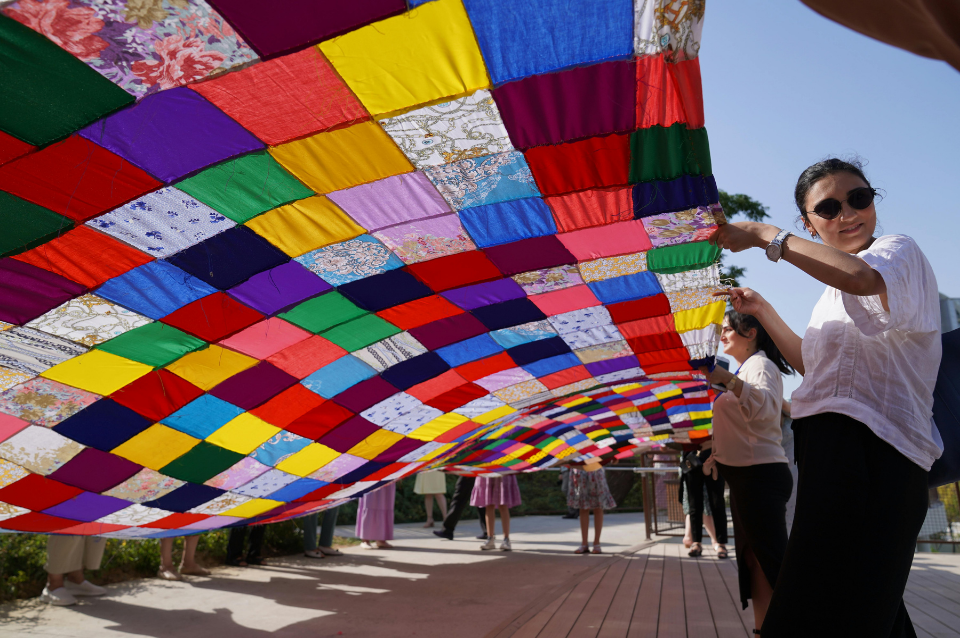
While researching this article, I found an opinion piece arguing that the United States of America is more like a patchwork quilt than a melting pot, and that is my hope as well. In a melting-pot society, people are expected to assimilate and leave their culture behind. But in a patchwork-quilt society, people can hold on to their culture, and it can be celebrated.
Kenneth Roseman, the author of the piece, explains the image of a patchwork quilt: “Each square of the quilt — and each element of our diverse population — retains its own distinct identity. But each is also sewn with firm connections to the entire fabric.” That is what I want to celebrate during this nation’s 250th anniversary. I want to celebrate the USA’s patchwork quilt.
After describing the symbol of the patchwork quilt, Roseman goes on to say: “And when we wrap ourselves in this enveloping garment that acknowledges our differences with respect and celebrates our commonalities with joy, we are enveloped in a warmth and strength that characterizes a vital and forward-looking people.”
Roseman then claims that the so-called “melting pot” image, which suggests that all Americans would somehow be identical, has never been true. He urges us to “consign that idea to the ash heap of historical fantasy and turn, instead, to a hearty celebration of a healthy, diverse American population determined to make of our nation, not some imaginary nightmare of the past, but a colorful, rich, vibrant dream of what our country can be.”
I want to celebrate that dream. I want to celebrate a country that is truly a patchwork quilt. I want to celebrate a country where diversity is honored, where people are proud of their culture and can be their authentic selves.
I want to celebrate a country that receives migrants, immigrants, refugees, and asylum seekers with open arms. I want to celebrate a country that welcomes the sojourner, as taught in the Old and New Testaments. I want a country that welcomes everyone to the table, as we, United Methodists, welcome everyone to the communion table because it is not ours but God’s.
I want to celebrate a country that remembers the words of Emma Lazarus written on the Statue of Liberty: “Give me your tired, your poor, your huddled masses yearning to breathe free.”
I want to celebrate a country where people follow one of the greatest commandments Jesus taught us: “Love your neighbor as yourself” (Mark 12:31, NIV). I want to celebrate a country that celebrates God’s diverse image-bearers.
I believe the dream of a patchwork quilt is true and can endure in this country if we take hold of it and continue to live it out.
I see the dream in my own life story, and I want to celebrate it. At least one set of my maternal great-grandparents came through Ellis Island, guided by the torch of the Statue of Liberty, from Poland. They found a new life in Detroit, just outside Hamtramck. My paternal great-grandparents came from Mexico to Texas. Then one set came to Sandusky, Michigan, as migrant farmworkers.
I come from a diverse family. I am Mexican-Polish American. Yo soy Mexicana y Polaca. I have always been proud of my multicultural, multiethnic heritage. It has not always been easy because I might not fit into a predefined box, but I celebrate that I am my own unique patchwork quilt square, a square made of red, white, blue, and green fabric that says Midwest Mexican and Polish.
I also see the dream come to life in my work with Immigration Law & Justice Michigan (ILJ-Michigan), one of our EngageMI ministry partners. I have volunteered with this nonprofit organization, which was launched by the Michigan Conference, for about 18 years.
ILJ-Michigan provides free and low-cost immigration legal services. Over the years, I have seen how it has helped immigrants, asylum seekers, refugees, and unaccompanied minors build new lives in this country. I want to celebrate organizations like ILJ-Michigan that support diversity and enrich the fabric of the USA and its beautiful patchwork quilt. See how you can volunteer with ILJ-Michigan.
My dream has always been the patchwork quilt, and if you know me, I am an actual quilter. I make quilts. But even before I made physical quilts, my goal for this country, for The United Methodist Church, for the Michigan Conference, and for local churches was the patchwork quilt. As a Hispanic/Latino Ministry Missionary, the Hispanic/Latinx Ministry Conference Coordinator, and now a Christian Life Coordinator in my local church, my vision and dream have been to work toward that patchwork quilt.
I know that, given the current circumstances in this nation, it is hard to celebrate diversity because the idea of diversity, equity, and inclusion has been undermined and vilified. But there is still much to celebrate. Look at how your communities and local churches are coming together. Many people are banding together to hold this country together, to advocate for a diverse population, and to celebrate the patchwork quilt we are creating. In 250 more years, I hope the patchwork quilt is more vibrant, more colorful, and stronger, and that it has not been torn apart.
Editor’s note: Want to walk alongside immigrants in your community but are not sure what to do? Check out the Michigan Conference’s new Courageous Communities Project. This UMCOR grant-funded project aims to resource church leaders who desire to support their immigrant neighbors with an online toolbox, consultations, and trainings. Learn more.
The publication of this article was made possible thanks to generous financial gifts from local United Methodist churches in Michigan through Ministry Shares. Thank you! Learn about the impact of Ministry Shares on mission and ministry in Michigan and around the world.
Last Updated on September 28, 2026