

Rev. Jerry DeVine, reflecting on Native American Heritage Month and his recent Native American Course of Study training, explains how Indigenous wisdom and spirituality can inspire hope, offering light in today’s challenging times.
Editor’s note: November is Native American Heritage Month. How will your congregation celebrate our Indigenous faith communities in Michigan? Read this article for ideas.
REV. JERRY DEVINE
Executive Director, Native American Course of Study
May the blessing of light be on you — light without and light within.
May the blessed sunlight shine on you like a great peat fire,
so that stranger and friend may come and warm themselves at it.
And may light shine out of the two eyes of you,
like a candle set in the window of a house,
Bidding the wanderer come in out of the storm. . . .
— Scottish blessing from an unknown source
The stories have similar patterns, though lived out in a variety of contexts. The murmurings come to life during shared meals, social media posts, and small-circle gatherings of trusted colleagues and friends. There are glimpses of anguish, anger, frustration, and fear woven together like a wind-tattered garment. The voices that I hear so often these days are those of United Methodist pastors and lay church leaders struggling to find and be light in what looks and feels like very dark times here in the United States.
The current socio-political dynamics in the United States have created a polarized environment in which any effort to live out the admonition of the prophet Micah to “act justly and to love mercy and to walk humbly with your God” (6:8, NIV) is seen as audacious and radical behavior. John Wesley’s three simple rules are chastised as soft liberal talk. Why would anyone want to “do no harm,” “do good,” and “stay in love with God”? How can you and I, as United Methodist Christian leaders, embody the just love of God against such forces of hurt and hate?
In my quasi-retirement, I have the blessing of serving as the executive director of the Native American Course of Study (NACOS), which trains licensed local pastors in The United Methodist Church. I also enjoy teaching several courses. Each time we gather, our students and faculty come from many different parts of the country and a variety of cultural and tribal heritages. My observation has been that as we each arrive for the gathering, we are carrying the weight of our concerns for the world and our respective communities on our hearts and minds, and it often feels as if it is on our shoulders.
Our most recent gathering was at Wesley Woods Camp & Retreat Center in Dowling, Michigan, one of our United Methodist camping ministries. By the second day of the gathering, it was as if a weight had been lifted. People breathed more deeply, basking in the gift of nature all around. Conversations in the classrooms and at the meal tables were more uplifting and oriented to hope.
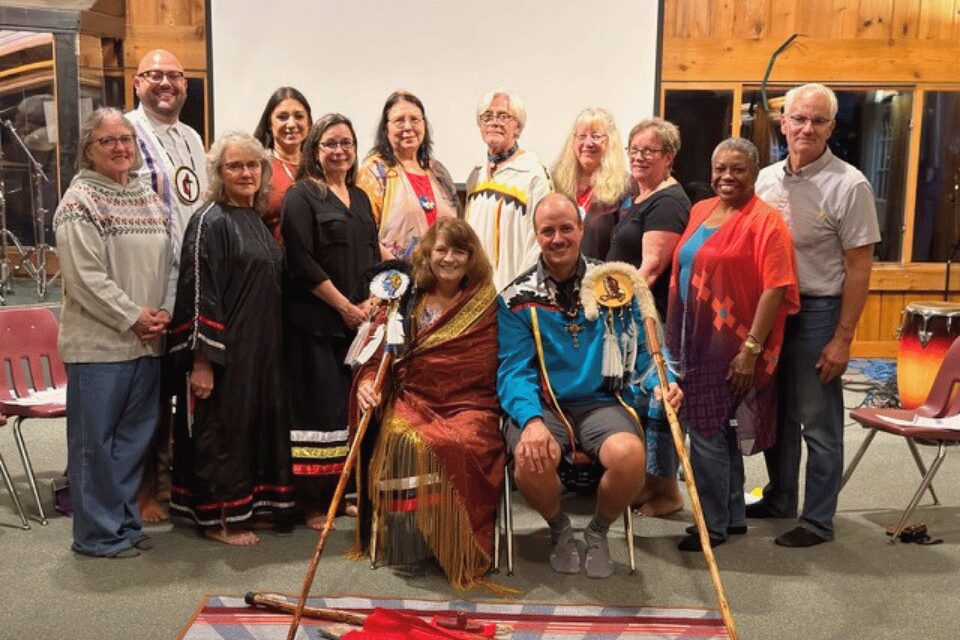
As this recent NACOS circle gathered, it seemed timely to offer this Celtic/Scottish blessing to them:
May the blessing of light be on you — light without and light within. . . .
And may light shine out of the two eyes of you,
like a candle set in the window of a house,
Bidding the wanderer come in out of the storm.
In Western culture, there is a tendency toward individualism. In such a worldview, worship can often be seen and treated as a transactional occurrence. The pastor, staff, and lay team create something that I then partake of and depart. Yet, in the biblical and historical tradition, and in many Indigenous Christian worldviews, worship and prayer are always communal. Sacred gatherings shape the values of the community, and the community gives context and substance to the gathering. It is always about us, and we, which includes me, but not just me. It is a sacred community that “bids the wanderer come in out of the storm.”
Bishop Steven Charleston, retired Indigenous (Choctaw Nation) Episcopal bishop, tells of the central role of community in shaping us and reminding us of our identity: “Our memory is always one of communal consciousness of culture, not of the rugged individualism . . . . Our value was (and is) on how each person resides within the context of his or her tribal community. . . . The Native story, . . . places no one outside the circle of community. It demands justice for people in every aspect of shared life and recognizes the spiritual value that all people are the children of God equally” (Coming Full Circle: Constructing Native Christian Theology, edited by Steven Charleston and Elaine A. Robinson).

As I led the Worship and Sacraments course this fall, I subtitled it “Sacred Ceremony and the Shaping of Community” to emphasize the capacity of gathered community to shape and support our collective values for living. I turned to two Traditional Indigenous sources to consider which values are shaped by our times of gathering in prayer and worship. The Seven Values/Teachings of the Lakota and the Seven Grandfather Teachings of the Anishinaabe reminded me a great deal of Jesus’ teachings and of what we often call the “fruits of the Spirit” in the book of Galatians. Here are those communal values:
-
- Seven Teachings of the Lakota: Fortitude, Generosity, Kinship, Prayer, Respect, Wisdom, Compassion
- Seven Grandfather Teachings of the Anishinaabe: Respect, Love, Truth, Bravery, Wisdom, Generosity, Humility
- Nine Fruits of the Spirit: Love, Joy, Peace, Patience, Kindness, Goodness, Faithfulness, Gentleness, Self-Control
At a time when the white Christian nationalist movement says and does things that can make it easy for my rage to become unleashed, I try to find my grounding in a better way. Dr. Martin Luther King, Jr., poetically wrote in his 1963 book Strength to Love: “Returning hate for hate multiplies hate, adding deeper darkness to a night already devoid of stars. Darkness cannot drive out darkness, only light can do that. Hate cannot drive out hate, only love can do that.”
The darkness of oppression and hate cannot illuminate my soul. That darkness cannot shine through me to offer hope to those seeking shelter from the storm. When I am faced with the deluge of destructive values and actions rampant in our country right now, I turn to the values that my primary community has nurtured in me. I turn to those who remind me of the communal values and to the one Creator whose values they are. That is my grounding.
I will still be angry at the abuses being cast wide at the most vulnerable among us. I will still stand with others against perpetrators of abusive power, protecting the vulnerable when I can. I will still be defiant against a fascist regime that seeks to alienate, isolate, and silence voices of compassion, empathy, and justice. However, my soul will rely on light and love for strength, not on darkness and hate.
In September, I spent five days at Wesley Woods within a circle of belonging. We each came carrying the heaviness of the world and the respective communities we live in. Yet, as we gathered, something sacred unfolded: prayer, sharing, learning, communing, laughing, crying, holding, releasing.
We became bread for one another. We became cleansing water for one another. We became a cup of life for one another. All of this is rooted in God’s good creation, in the unconditional love shown through Jesus Christ, and in a community of belonging in which each is welcomed as the unique self that they are. We were rooted in the core teachings / values listed above and shaped by them during our time together. We became audacious light for one another and together for the world.
Your community needs you — the unique, audacious light you are. Gather often with those who help fill you with new light and life. Then may light shine out of the two eyes of you, like a candle set in the window of a house, bidding the wanderer come in out of the storm.
May it be so. Aho. Amen.
Explore Further
-
- Additional resources to gain more understanding of Indigenous Christian insights include Indigenous Theology and the Western Worldview by Randy S. Woodley; A Native American Theology by Clara Sue Kidwell, Homer Noley, and George E. “Tink” Tinker; One Church, Many Tribes: Following Jesus the Way God Made You by Richard Twiss; and Holy Smoke: The Contextualization of Native American Ritual and Ceremony by Casey Church.
- To get more involved alongside United Methodist Native American ministries here in Michigan, read this earlier news article.
- November is Native American Heritage Month. To learn more about the twelve federally recognized Indigenous tribes in Michigan, review this list.
Last Updated on November 4, 2025