
Following a trip to Rome, Rev. Elizabeth Hurd reflects on the many ways our Christian faith has endured, having experienced the power of God’s love and the story of Christ’s redemption.
REV. ELIZABETH HURD
Birmingham and Berkley: First UMC
The oldest known image of the Virgin Mary is found in the Catacombs of Priscilla in Rome, Italy. Estimates date it to 250 CE.
I didn’t know about this fresco when I booked tickets to the Catacombs of Priscilla. They were just the closest to the Capuchin Crypt, where my friends and I had been touring earlier that morning. When the tour guide pointed it out, it took my breath away.
Not because the fresco is sweeping or grand (the catacombs are certainly no Sistine Chapel), but because there she was. The mother of our Lord. Theotokos. God-bearer.
Mary.
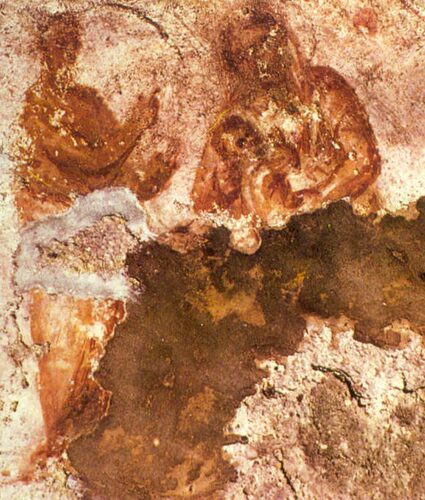
The picture has, obviously, faded over time. But we see Mary holding the baby Jesus to her chest. In the background, an unidentified man points at a star. We don’t have the full scene, so our imagination has to fill in the story. When I saw Mary, Jesus, and a man pointing at a star, I immediately thought of the Christmas story. Perhaps we see Mary meeting the magi, who show her the star that led them to Jesus.
Craning my neck to stare at the fresco for as long as possible, trying to commit it to memory because the Vatican doesn’t allow photos inside the catacombs, I felt the holiness of the moment.
I’m a Christian, alive in 2026. Mary’s story is deeply familiar to me. I read it every December. I preach on it. I keep an ever-growing nativity collection on display in my home year-round. I identify with Mary, not because I’m a mother. I don’t have kids. Besides, Mary is so much more than a mother.
I identify with her because she was a woman brave enough to say yes to God’s call. She trusted God more than she feared the consequences of her yes. Not to mention, her Magnificat expressed the profound hope she had in God’s liberative justice and mercy triumphing over the evils of the world. She is a model of bravery, trust, and hope in God that I try to follow. Her life and story hold meaning for me.
Her life and story held meaning for a Roman Christian in the 3rd century, too. Whether this Roman Christian identified with Mary as a mother, found promise in her courage to say yes to God’s call, or simply held her in high esteem as God-bearer, we may never know. But she held meaning for this person. Enough meaning that they chose to paint her on their tomb.
You know, the story of our faith matters. It has been passed down from generation to generation and has endured for millennia. It has endured because people have told the story of our Savior, Jesus, God incarnate, in many ways.
I will acknowledge, of course, that there have been times when the story of our faith has been abused and twisted for the sake of worldly power. You cannot escape this fact in Rome. The basilicas around the city remind one of the marriage between Christianity and empire, since they were originally designed as civic buildings. Churches were placed just outside the Jewish Ghetto because conversion was a person’s only escape from the overcrowded, smelly, flood-prone area that Pope Paul IV forced them to live in. Italy is home to one of the oldest Protestant denominations in the world, the Waldensians, who were deemed heretics and heavily persecuted by Rome. Violence, persecution, oppression, conquest, power: these are ways our Christian story has been told throughout time.
Yet, the Christian story has been told in many beautiful ways as well.
Believers have painted images of faith on the ceilings of catacombs and chapels. They’ve shared communion in small house chapels and in grand sanctuaries. They’ve quoted scripture and preached sermons. They’ve made sandwiches for the hungry and passed out water to the thirsty. They’ve invited people into the kingdom and prayed for those in need of prayer.
And perhaps this is why the story of our faith has endured. Not because it was married to empire and gained followers through conquest, but because, over and over again, believers have found ways to tell their stories and share God’s love in quiet, simple, faithful ways. Believers have, again and again, found ways to make sure others knew Jesus and found community and home in Jesus.
The day after I saw the fresco, my class went on a walking tour of Caravaggio’s paintings in various churches. One church is the Basilica di Santa Maria del Popolo, which houses paintings depicting the conversion of Paul and the crucifixion of Peter. The paintings were certainly impressive, but what captured my attention most was a scene unfolding at the front of the sanctuary.
Three brothers were kneeling in prayer. The two older brothers were teaching the youngest how to pray. They walked him through how to kneel and how to hold his hands. They whispered words to him. When they got up, they taught him how to kneel and cross himself. They came back and taught him to do the same. These two older brothers were passing down their faith by teaching their younger brother this prayer ritual.
I couldn’t help but think of all those who taught me about my faith, who made sure I knew how to fold my hands and how to dip communion bread into a cup of grape juice. I couldn’t help but think of how I now have the privilege of sharing the stories and traditions of faith with youth at camp and with the congregations I serve. I couldn’t help but think of the responsibility I have to continue sharing this faith so that, perhaps, 1,776 years from now a young pastor in a doctoral program will go to Rome, gaze up at the oldest known image of the Virgin Mary, and feel the power of God’s enduring love and Christ’s enduring story for themselves.
The publication of this article was made possible thanks to generous financial gifts from local United Methodist churches in Michigan through Ministry Shares. Thank you! Learn about the impact of Ministry Shares on mission and ministry in Michigan and around the world.
Last Updated on July 13, 2026