
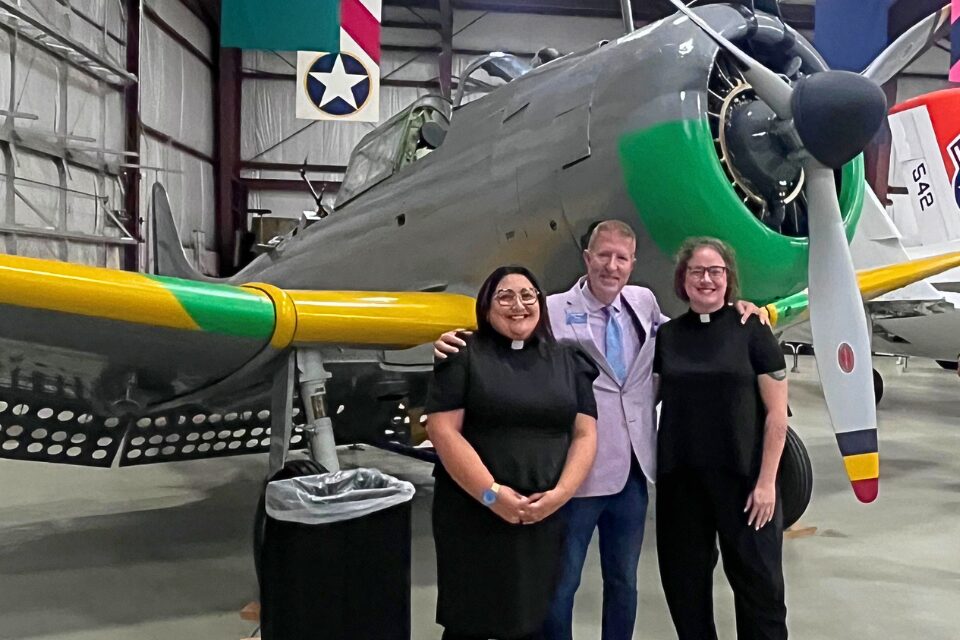
Two United Methodist pastors rallied to honor the life of a World War II Navy pilot who died in a plane crash in Lake Michigan and never received a proper burial and memorial service.
JAMES DEATON
Content Editor
When Troy Thrash, president and CEO of the Air Zoo Aerospace & Science Center in Portage, first received the request from the National Naval Aviation Museum to finish restoring the only surviving Douglas SBD-1 Dauntless (Model One) dive bomber in the world, he balked.
“We’ve got two projects going on,” Thrash initially told them. “We just don’t have the space to do it. So we said no.”
More than a world-class aerospace and science education center, the Air Zoo is also a renowned Restoration Center, where staff and hundreds of volunteers spend hours rebuilding aircraft to near-original condition, all in public view. The Air Zoo Restoration Team takes great pride in preserving history, from the engineered marvels of the sky to those who navigated them.
But the caretakers of the SBD-1 were persistent and asked Thrash to come out a few weeks later to see the legendary aircraft and reconsider. In several key battles, the Dauntless is credited with doing more than any other aircraft to change the course of the war in the Pacific.
This particular plane was most recently housed at the Flying Leatherneck Aviation Museum in San Diego. It crashed into Lake Michigan on November 21, 1942, during an aircraft carrier qualification training flight, and was recovered in 1994 before being sent to California for restoration.
Thrash decided to go see this aircraft and printed off the entire military file to learn about the crash, the aftermath of the crash, and the life of the aircraft’s pilot, Ensign Herbert McMinn, who died in the waters of Lake Michigan.
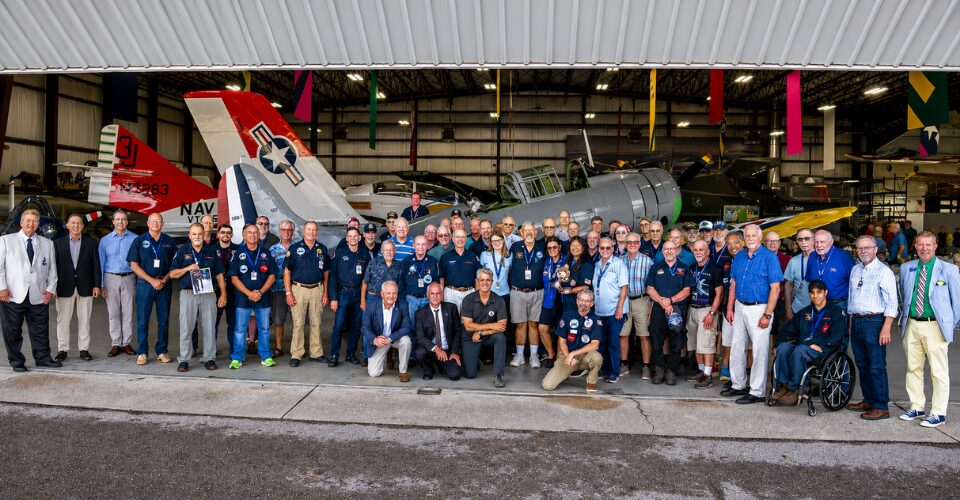
Aircraft carrier qualification training was critical to Allied success during World War II, and much of it took place on the Great Lakes. After the attack on Pearl Harbor on December 7, 1941, a U.S. Navy base north of Chicago became a key location for basic training for recruits enlisting in the war effort. The number of sailors grew from around 6,000 when the United States entered the war to over 100,000 by September 1942. Unfortunately, from 1942 to 1945, some 130 aircraft went to the bottom of Lake Michigan due to accidents during training operations.
On the plane to San Diego, Thrash learned about Ensign McMinn, a young man from rural Gouldbusk, Texas, who worked with his father in stock farming before pursuing a degree in animal husbandry at Texas A&M. McMinn loved music, played the viola, and was passionate about aviation. He was also raised in a faith-filled Methodist home.
McMinn enlisted in the U.S. Naval Reserve shortly after graduating and entered active duty on July 22, 1942, as a Naval Aviator, having received training at the Naval base near Chicago. On November 21, he was flying alone, heading from the USS Wolverine training aircraft carrier to the base, when his plane went down about five miles east of Chicago. There was one eyewitness to the crash, with no visual evidence that Ensign McMinn perished.
As Thrash read further, he uncovered letters exchanged between Ensign McMinn’s parents and Navy leadership. The parents’ letters evolved as reality and grief set in, from “please find our son” to “I know you are not going to find our son alive, but please keep searching.” The family was tenacious, and their letters continued even after the war ended, into 1946.
“So they just kept up hope,” says Thrash. “They were Methodists, and I think their belief in God helped them know that one day they would get that closure they needed for their family.”
The story of Ensign Herbert McMinn captured Thrash’s heart on the flight to San Diego to see the SBD-1 and wouldn’t let go. “I could have turned the airplane around and gone back home,” notes Thrash, “because I knew immediately this was less about restoring that important aircraft and more about restoring Ensign McMinn’s story, especially for him and his family.”
Thrash was ready to say yes before even seeing the SBD-1 in person, trusting the project would fall in line perfectly with the Air Zoo’s mission: “Yes, we care for airplanes and spacecraft, but ultimately, at the end of the day, they are just big hunks of metal and rubber. It is the stories of the people — the dreamers, the innovators, the designers, the builders, the maintainers, and the pilots — that really bring these projects to life.”
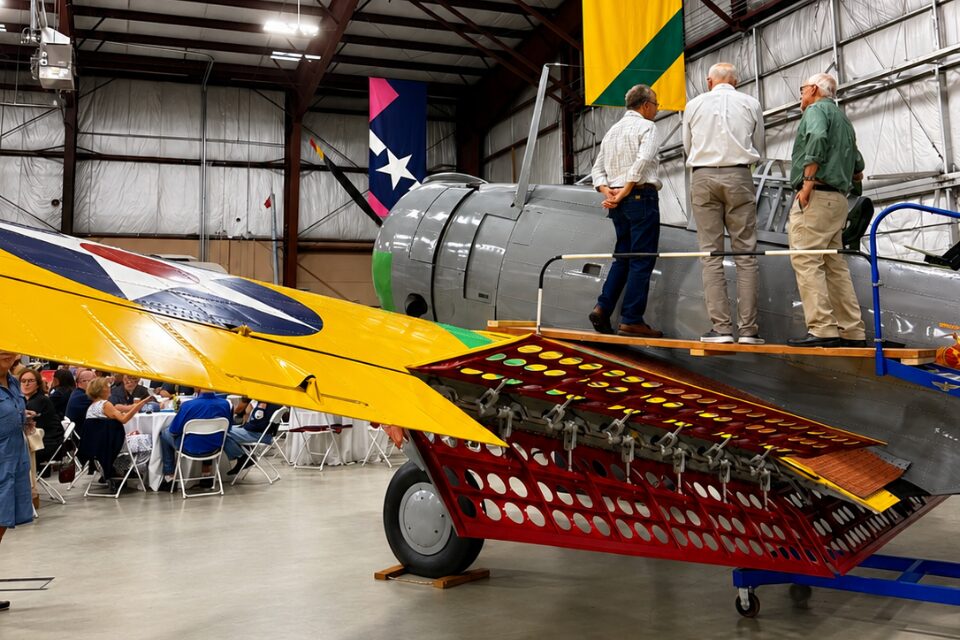
On August 2, 2021, the SBD-1 dive bomber arrived at the Air Zoo Restoration Center and began its final phase of restoration. Around this time, Troy had learned that Ensign McMinn’s two great-nephews, Brian and David Lynch, were living in Texas and did not know the aircraft their relative had piloted was going to be restored. This started a wonderful friendship between Thrash and McMinn’s family.
Earlier this year, as the SBD-1 restoration neared completion after five years of dedicated work by the hands of over 120 Air Zoo volunteers, Thrash learned that Ensign McMinn was never given a proper burial or service of remembrance by the Navy.
“There was still no closure in 2026, nearly 84 years after his death,” explains Thrash. “So the Air Zoo team decided that not only did we want to have a big celebration at the end of July to mark the restoration of the only SBD-1 left in the world, but we also wanted that final, important celebration of life for Ensign Herbert McMinn, knowing that Brian and David were still devout Methodists.”
Only two people came to Thrash’s mind as the right people to provide the proper care, research, and ultimately closure for Ensign McMinn’s family: Rev. Dr. April Gutierrez and Rev. Jess Joyce, his two pastors at Portage: Chapel Hill UMC, where he is a member. Thrash reached out to both, and they enthusiastically said yes.
On July 27, some 200 people came to witness a full-circle story be told, as volunteers, staff, honorable military guests, family members, and two United Methodist pastors gathered at the Air Zoo’s Flight Discovery Center to celebrate the SBD-1’s complete restoration and Ensign McMinn’s life.
This special event began with a beautifully crafted memorial service by Revs. Gutierrez and Joyce, which set the tone with scripture, prayer, sermon, song, and blessing. Both pastors took hold of this story, honoring Ensign McMinn’s service and sacrifice and providing holy space for the family to grieve their loss and finally find closure.
“What they delivered was beyond anything I could have expected,” says Thrash. “The family was truly honored and humbled by the work they put in and the message they delivered. Even though no one there had ever met Ensign McMinn, the grand-nephews came with their families, and we heard about the peace and relief they experienced. Now this child of God has been released, and his family has been released from the burden of not having had that opportunity to give his soul to God in a service as we had.”
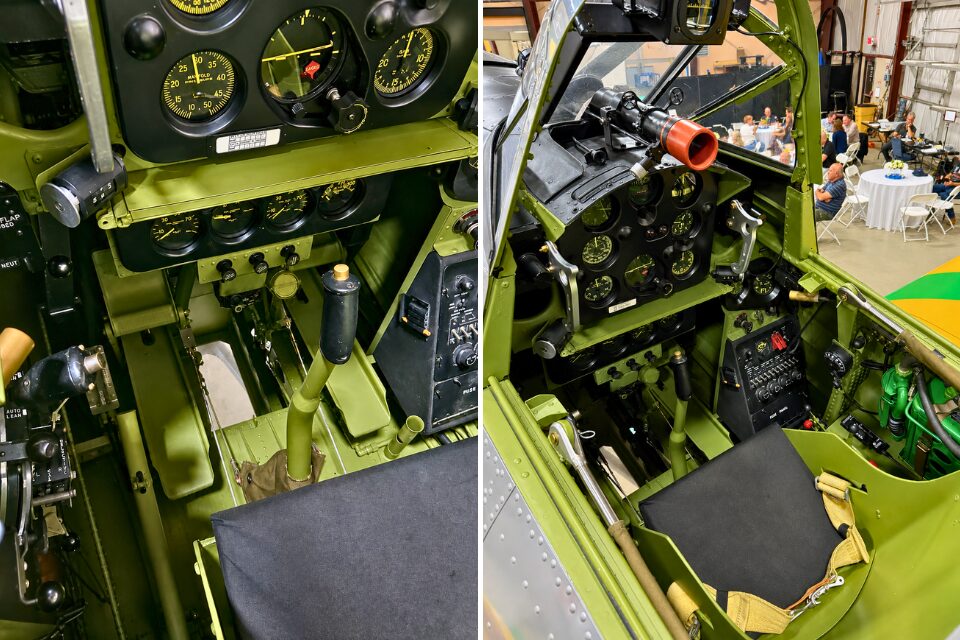
Since Ensign McMinn’s body was never recovered, Thrash notes the service of remembrance was held in the shadow of this serviceman’s last location, the SBD-1, his final resting place. “He was the last person in that cockpit, and everyone felt that. The family felt that when we allowed them to sit inside the aircraft.”
The memorial service was also a time of closure for the Air Zoo volunteers and staff, who cared for the SBD-1 restoration for five years and shepherded it to completion.
Thrash spoke about the impact of this amazing project on his volunteers and himself: “Knowing that the hundreds of volunteers recognized not just the aircraft but who Ensign McMinn was as a son, as a pilot, as a child of God, and knowing the connection they built with this man they had never met before, but knew was a brave, courageous, holy man, really, honestly moved me every day that I walked into our restoration center and saw our team working together to bring that aircraft back to life.”
Ensign McMinn’s story and the story of the legendary SBD-1 is now complete, thanks to the dedication of United Methodists in Michigan and the volunteers and staff of the Air Zoo, and will be carried on, for its journey in Portage is temporary.
The SBD-1 is now on display at the Air Zoo for a limited time, and the public is welcome to see it and learn more about Ensign McMinn’s story. Visitors will also get to see more items from Ensign McMinn’s life, including his viola and a Texas A&M flag, flown over the campus in his honor. Plan your visit to the Air Zoo.
Troy explains further, “It’s going to stay at the Air Zoo for about nine months, and then it is going to go back home to Irvine, California, to the new Flying Leatherneck Aviation Museum. So this aircraft and Ensign McMinn’s story will return to where the restoration really began at that museum. So it’s a full-circle story.”
The publication of this article was made possible thanks to generous financial gifts from local United Methodist churches in Michigan through Ministry Shares. Thank you! Learn about the impact of Ministry Shares on mission and ministry in Michigan and around the world.
Last Updated on August 18, 2026