
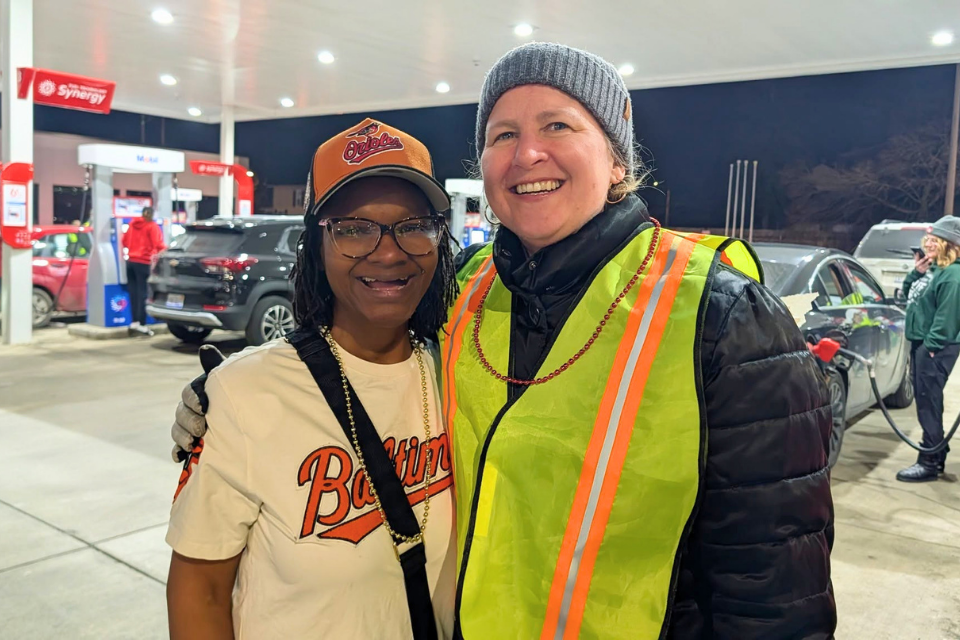
With Lent starting in early February next year, it’s not too soon to plan. Sycamore Creek UMC shares how buying gas for neighbors takes its Lenten tradition beyond the church walls. Pastor Tom Arthur offers a checklist to help your congregation adapt this idea.
What if a church played jazz with its liturgical traditions in a way that helped it reach new people? That’s the question Rev. Tom Arthur, pastor of Sycamore Creek UMC’s Eastwood campus in Lansing, likes to ask. Ash Wednesday is one example. The whole point of the day is to humble oneself: we came from the dust and will return to the dust. As Arthur puts it, “Human, remember you are from the humus.”
Sycamore Creek has sought ways to practice humility beyond an Ash Wednesday service. For many years, the church, a three-campus multisite with 50 to 150 people at each campus on Sundays, has observed Ash Wednesday by going to the gas station next door, standing outside in the cold, and buying gas for people. “The Lord has provided some of the coldest days of the season on those Ash Wednesdays,” Arthur says. Fittingly, the station is owned by an immigrant named Ash. Arthur continues, “In this way, we humble ourselves by serving our community.”
It also meets real needs. Some neighbors have come back year after year for free gas. The church started by offering $5, which bought a couple of gallons, but inflation has since pushed the gift to $10. Each year there are one or two people whose tanks volunteers fill completely after hearing their stories. “There’s not much to do once you start the gas flowing besides stand and talk to the person and provide a listening ear,” Arthur says.
People often ask why the church is doing this. Volunteers explain that it’s their way of celebrating Ash Wednesday, and when people ask what that is, they describe it as the beginning of Lent, the countdown to Easter. When people ask whether they need to do anything in return, the answer is no. Many say they’ll come to worship on Sunday, but Arthur admits he can remember only one or two who ever did, and they didn’t stay. “The new people we’re reaching who show up on Sunday aren’t necessarily the people we’re giving free gas to,” he says. “It’s the people who like that we’re investing in our community in this unique way.”
Is it just transactional? “Maybe,” Arthur says. But the response is often so large that volunteers get overrun, and people waiting in line spontaneously get out of their cars to help direct traffic. Because the church returns to the same station each year, relationships have grown with the staff and the owner. Every year, Ash reaches into his register and hands volunteers a couple hundred dollars to give away on his behalf. Many recipients say they weren’t sure how they’d get to work the next day. “Outreach and mission are never purely one thing or another,” Arthur says. “It’s relational and transactional at the same time.” Those relationships grow slowly over time, through consistent investment in the neighborhood.
More recently, Sycamore Creek moved the giveaway from Ash Wednesday to Mardi Gras. “People recognize Mardi Gras more easily and quickly than Ash Wednesday,” Arthur explains. “It makes sense to the average non-churchy person.” The event now has a party atmosphere, with free Mardi Gras beads handed out alongside the gas. One year, a DJ from a local radio station joined in, and the day was filled with smiles and laughter.
With three campuses, the church now runs the event at three gas stations spanning the city, suburbs, and countryside. This past year, several other Lansing-area United Methodist churches joined in. Together, they gave away thousands of dollars in gas at six stations, and local news outlets highlighted The United Methodist Church’s shared effort across the region. And this year, Arthur notes, “the Lord even provided a warm Tuesday.”
Arthur shared this outreach idea so other local United Methodist churches might be inspired to create their own or something similar. Now is the time to plan for Lent and Easter.
Tom Arthur’s Nuts-and-Bolts Checklist
Ask a local gas station ahead of time. It may take asking two or three before finding one willing to participate, but after the first year it gets easier because everyone understands the request. Arthur offers to help churches near a QD open the door.
Put a couple of people on the street with yard signs reading “FREE Gas Now!” That’s really all it takes. Arthur recommends against advertising in advance: “You might be too successful and end up with a logjam of traffic.”
Have volunteers wear fluorescent vests at each pump. “It’s amazing how someone becomes an authority figure with a yellow vest on,” he says. When a car pulls up, volunteers ask, “Would you like $10 of free gas?”
Decide how to pay. Volunteers can hand drivers a $10 bill so they can pay inside and add anything they want, or, with enough volunteers, a runner can go in and pay.
Pump the gas and have a genuine conversation. Volunteers should say what church they’re from and why they’re there, while taking care not to sound like they’re buying attendance or doing a favor. “The gift really needs to be free,” Arthur says. “Trust the Spirit.”
Pull the signs when about $200 remains. Things take time to wind down. Give out a final round, take off the vests, and keep a little cash for latecomers who heard about it from a friend. It’s fine not to hand out every dollar; a calm slowdown is better than leaving a line of disappointed people.
Huddle with volunteers afterward. Celebrate what they saw God do, the people they met, and the stories they heard. Then invite someone to share a story during the Sunday offering, and thank the congregation for the generosity that makes this kind of service possible.
Local church leaders interested in discussing this ministry idea further with Tom are welcome to contact him directly at [email protected].
The publication of this article was made possible thanks to generous financial gifts from local United Methodist churches in Michigan through Ministry Shares. Thank you! Learn about the impact of Ministry Shares on mission and ministry in Michigan and around the world.
Last Updated on October 19, 2026