

A three-day ice storm hit northern Michigan at the end of March. Lake Louise Christian Community forests were among three million woodland acres suffering the impact.
KAY DEMOSS
Michigan Conference Communications
Below-zero temperatures across the tip of the Michigan mitten allowed ice to accumulate from March 28-30, 2025. The freezing rain just kept coming. By Sunday night, “You couldn’t count to ten without hearing what sounded like gunshots” as the tops of trees snapped and fell to the ground, as described by Neil Haney, Executive Director of Lake Louise Christian Community (LLCC). On Monday morning, Haney and his wife, Stacie, spent nine hours with a chain saw getting from their house down their driveway to the road.
Weather watchers at Great Lakes Energy sounded the alarm on Friday, telling customers to be prepared for multiple days without power. When the lights went out at Lake Louise, they didn’t come back on at the camp for another 339 hours. Haney says Great Lakes explained they were engaged not in a restoration but a rebuild of their power grid in the area. The National Weather Service reported the event as “a catastrophic disruption of daily life.”
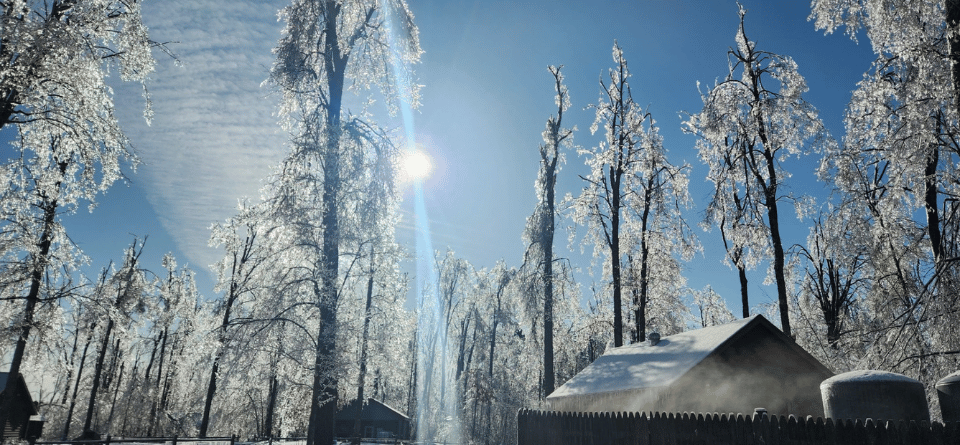
When asked if there was ever any doubt that the camping season at Lake Louise would not happen this summer, Haney replied, “That was never in question.” Today, five months after the sleet fell and melted, campers have come and gone back home as recovery continues across the community.
Cottagers Hunker Down
Terri Denhof is the president of the Cottagers’ Council of Lake Louise Christian Community. She and her husband, Scott, moved to Lake Louise from Wyoming in June of 2024. “This was our first winter,” Terri says, “and it was a doozy!” However, Terri is not a newcomer. She is the third generation to enjoy the cottage built initially by her grandparents in 1946.
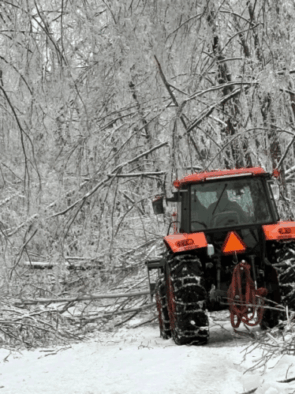
Most people are three-season cottagers at Lake Louise. The Denhofs, however, are among about 15 families who are year-round residents. She calls their first 48 hours in the ice storm “absolutely terrifying.” They drove back from dinner in town on Friday night, along with fellow cottager Curt Skowronski, to discover the power was out and found a tree blocking their path. After clearing it, they heard more trees crashing to the ground all around. We dropped Curt off, and he ran a quarter of a mile on foot. We put the truck in 4-low and had to drive over fallen trees to get home,” Terri remembers. The noise made by tree crowns hitting the ground went on for the next two days.
The Denhofs praised the Haneys for putting themselves at risk in their efforts to reach residents and help them escape. The Cottage Council, along with the camp, contracted a neighbor with a logging claw on his tractor to aid the effort. It took him 12 hours to cut a one-lane path through the downed trees and power lines blocking the 1.2-mile length of the access road into the cottages.
There were two immediate goals, according to Haney. “Get the trapped people out, and get the power company in. Great Lakes Energy was responding but declared, ‘we can’t repair your line if we can’t get to those lines.’” On every ten feet of road, there was a pine tree snapped and entangled with wires.
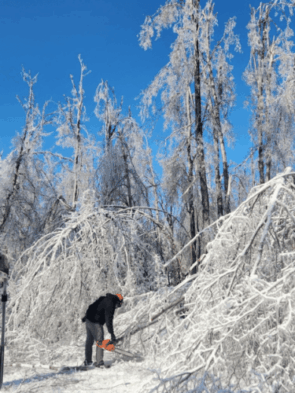
One couple who owns a large cottage with a generator opened their home to neighbors. Others stuck it out in their own cottages with wood burners and battery devices. Some required persuasion. Scott Denhof, a veteran of ski patrol, recalls telling his elderly neighbor who had no heat, “Jean, pack up your stuff! Mimic my steps and watch where you put your feet.” Having cut a path between her door and his truck, Scott drove her a half mile, then walked her 150 feet to refuge in a nearby cottage.
Some remained to assist with cutting and removing trees. Terri notes, “About a dozen people were around through the thick of it.” Others went downstate to await the return of electricity. The power finally came back on in the cottages after 19 days.
Millie Janka, a long-time Lake Louise resident, remarked on Facebook, “It is a ‘war zone’ of ice and fallen trees here.” Scott explains, “The storm was related to the altitude. The hills around Thumb Lake [Lake Louise] got some of the worst.” He adds, “The weather guys equated the carnage to a hurricane.” Terri reminded those who visit Lake Louise that the danger is not over. “A widow-maker came down during high wind in mid-July and took out my tailgate and window.” She expects the “colors to be vastly different this fall. We won’t know until spring how many trees will make it.”
Campers Came Prepared
On Friday night, “I noticed a sound I’ve never heard before,” Greg Lawton recalls. “It was the sound of hail hitting a frozen lake.” He was away when the ice came, having driven south on Saturday. In his role as Lake Louise’s Director of Camping and Outreach, Greg was in Marshall promoting the next camping season.
Hearing all the weather alerts, he asked himself, “Do I intentionally drive into a disaster zone? They needed my help, so I went north.” Greg’s primary role during the first week of recovery was to keep fireplaces burning in the camp to prevent pipes from freezing. After five days, he and his cat moved to a friend’s house in Boyne City and worked on preparation for the 2025 camps off-site.
Lawton was concerned about how summer arrivals might grieve the damage they encountered for the first time. “People just couldn’t fathom an ice event that stretched from Boyne Falls to Alpena,” he says. “The amount of ice was beyond imagination.” He created a grief resource for use by camp deans. The five stages began with, “Let it all sink in. Notice what is missing and what is present. Talk to someone about the things you miss or notice.” Another suggestion called campers to imagine the future: “What new trails need to be trodden? How might we move together into a new day as we wait for nature to rebound?”
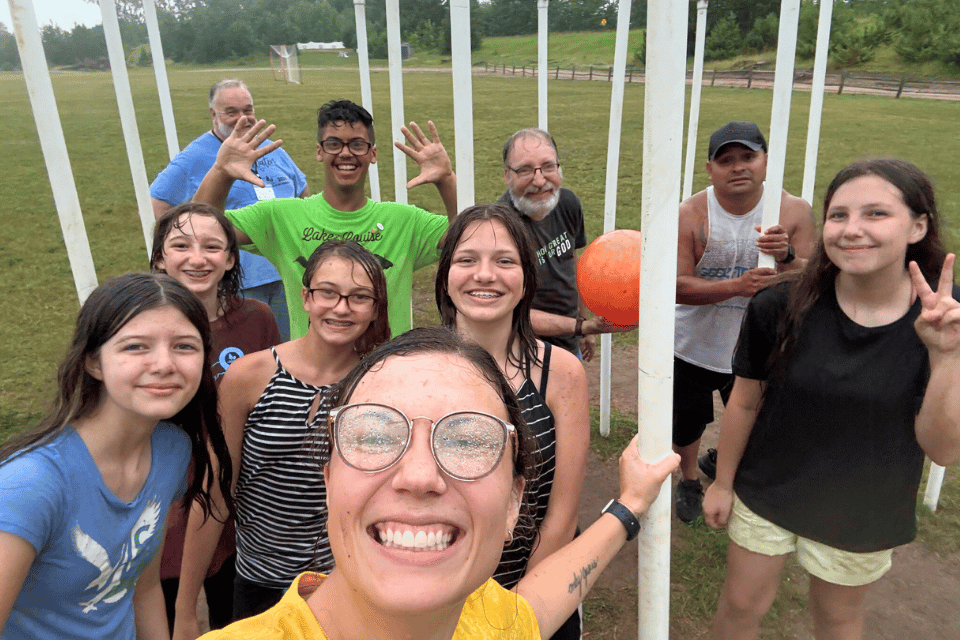
As the camp season drew to a close in early August, Greg was happy to share that the storm had no negative effect on registration. “In fact, our numbers are up,” he says. “Most were in shock when they showed up, however, especially adults who had been here many times.” Youth who had been to camp multiple times were also surprised. “Newcomers, of course, had no expectations,” he continued.
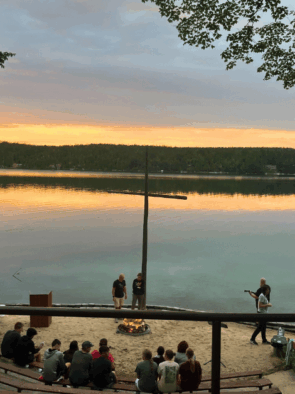
Haney agrees, “I would say the children are amazingly resilient. Most of them haven’t noticed the stumps and brush piles. They don’t see those because they came here to see their friends.” Haney did comfort one senior high camper who grew up around there. He found her sitting on a stump and writing in her diary. “I began chatting with her and she was almost in tears,” he recalls. “This was the tree, right beside the bell, that she had grown attached to. She had journaled beneath its branches through the years.”
“Change is always hard,” Greg reflects. It is difficult when you have experienced a certain way of living in a space, and then you can’t do that. The biggest thing is there’s not much shade, so it’s hotter everywhere.” Those arriving for Camp Beloved in June wanted to know how to hang their clothesline. Greg told them, “You’ll just have to find a new tree.”
The theme for the 2025 camp season, chosen prior to the ice storm, was “Be Transformed.” The post-storm setting provided opportunities to explore that theme. Delaney VanderPloeg arrived for the high school camp in July after two seasons attending middle school camp. “My first impression was, ‘Oh, wow! That’s a lot different!’” Then she realized, “Now you can see things that you couldn’t see before,” which she thought was a good thing. Delaney also reports feeling safe. “We were told, ‘Things are getting fixed. Don’t worry.’”
Neil Haney shares that there was very minor damage to the buildings at the camp. “We were incredibly blessed to have so little structural damage. Some trees near buildings had to come down for the safety of the kids.” The low ropes challenge courses suffered the most damage. “There was sort of a domino effect in that area where there were fewer trees. Same along the athletic field,” he explains.
Harvest of Trees
The trees of Lake Louise have provided more than shade over the years. They have been a source of revenue, as well. In 1949, Harold Redman, a layman from Alma Methodist Church, provided the Lake Louise Trustees with 100,000 pine seedlings and money to plant them. Thus began a forest management program of a red pine plantation that continues to this day. Metcalfe Forestry, based in Grayling, has been under contract with Lake Louise Christian Community to supervise an ongoing harvest of trees on a 20-year rotation.
“We were so blessed to have that in place,” Haney says. “I was in crisis management mode. I wasn’t thinking about forestry. But 72 hours after the storm, Bryce Metcalfe called to tell me he had four crews ready to head our way to salvage what we can.” Less than a week after the devastation, Lake Louise’s 1,700 acres of forestry land were being cared for.” Such speed was important to prevent insect infestation and staining of the downed wood.
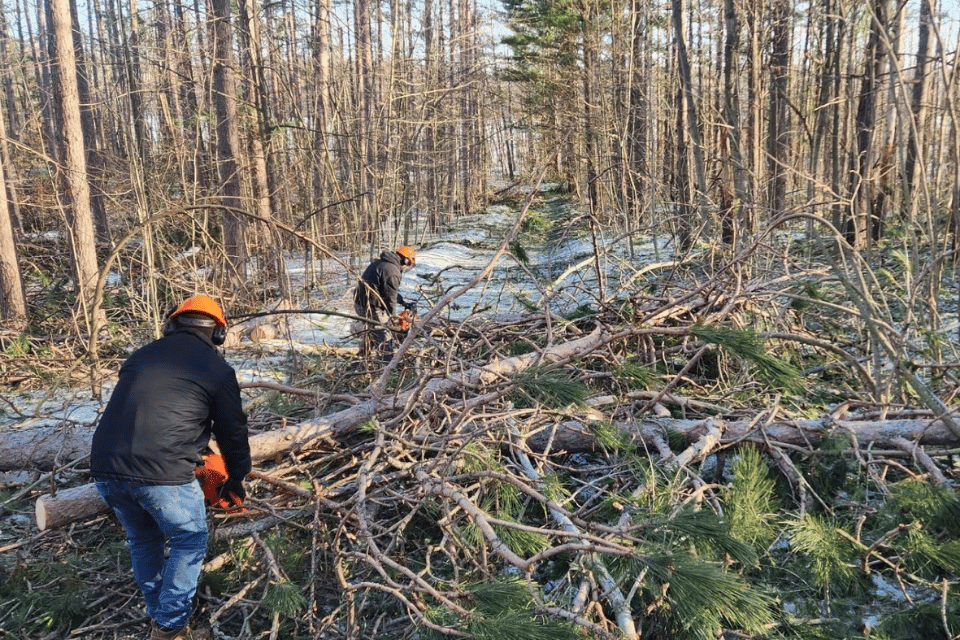
And it was not only about recouping some money. “This cleanup helped to reset the forest to recuperate faster,” Haney explains. “An injured forest must go through a dying stage before it can be reborn.” It will be another 60 years before trees can be harvested, but without the essential cleanup, no commercial logging company would return to an area with unhealthy and low-quality trees.
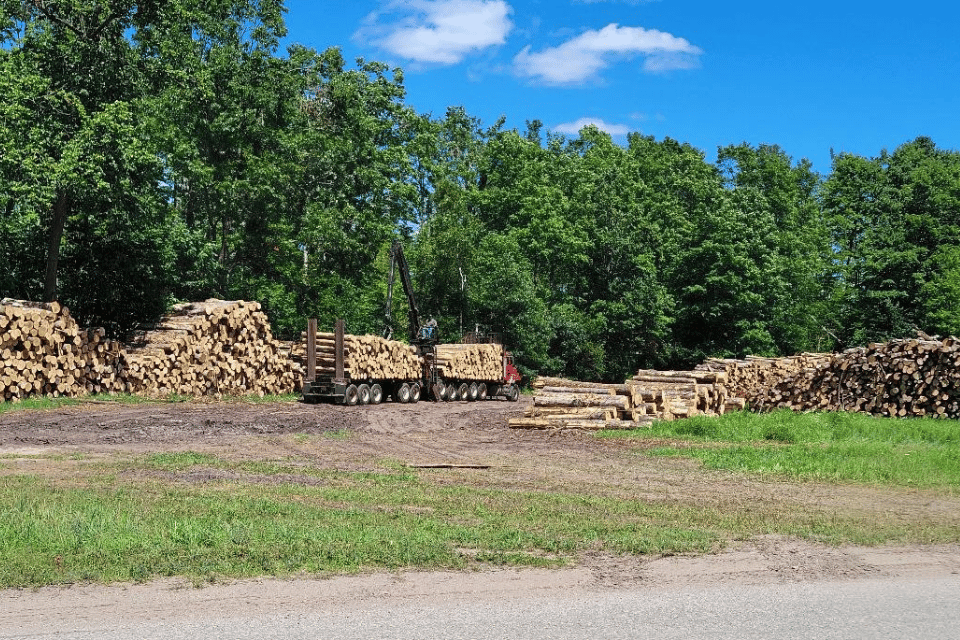
With 70% of the forest cleanup completed, about $1.1 million has been gained, 85% of which will go into the Lake Louise Endowment Fund. Sawmills have stopped accepting red pine “because the beetles have moved in.” Harvest of hardwoods will continue this fall and into next spring. That’s good news. But Haney notes, “Had we harvested as we had planned over the next 30 years, the revenue would have been in the $5-7 million range.” “This logging had to happen,” says Terri Denhof. “Our logging plan reached out to 2050, but it got pulled forward by the storm.”
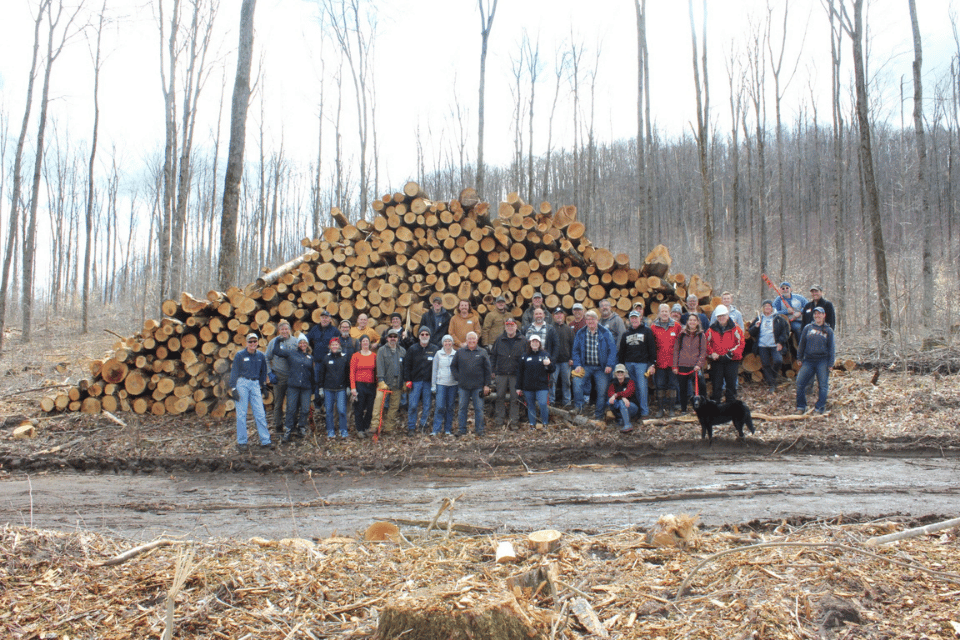
Reforestation began within days of the ice melting, when volunteers helped plant 1,600 saplings. Lake Louise is applying to the U.S. Department of Agriculture for a grant to continue planting. Haney remarks, “The USDA knows how to do crop damage. But trees are not corn and soybeans. We anticipate getting something, but we are not certain of the amount or what it will cover.”
Haney is working with the Conservation District to get more saplings. October is the anticipated time for the next planting. Fall cleanup weekends are also being planned. Watch Facebook: Lake Louise Christian Community, Camp & Retreat Center for volunteer opportunities.
Promise of New Life
It was a disaster. Still, there is hope. Greg Lawton points out, “Nature comes back. There are flowers here that I had never seen before because there is more light.” He encourages people to take the long view. “Back in the 1920s, there were hardly any trees here after the logging boom that ended in 1900. Then people planted red pines.” Lawton is eager to see “what gets planted now, what grows, and how we come to new understandings because of that.” As the landscape changes, he expects new revelations. “Things will grow,” he says, “and then there will be a big reveal. I am excited about that.”
Many people have visited Lake Louise since its founding in 1934. “Sometimes when people return after being gone for 20 or more years, they often say it feels the same even if it looks different,” Lawton reflects. “When they arrive, they know where they are. There is a special feel here, even in a new forest.”
“We got knocked down, but we got back up” is how Terri Denhof puts it. As fall approaches, the cottager community continues to contribute to the recovery. “This is an extraordinary moment that brought out the extraordinary in people,” she concludes.
Neil Haney is forward-looking. “I tell people, ‘Give it five years and if you’re still grieving, then I don’t know what will help you.’” He believes, “Most people after five years will see a forest that is close to what they remember. And they’ll also see sun-dependent species we haven’t seen since the last timbering era. Chestnuts, cherry trees, and basswoods that were choked out before.”
Lawton invites all who love Lake Louise, “Be gentle with yourself and those around you. Some will carry these changes in stride, and some will suffer greatly at what is forever changed. Listen to each other and support each other as best you can. And in all things, remember that God loves us still.”
Editor’s note: To contribute to the storm cleanup or ropes course repair at Lake Louise, visit their online donation page. Checks made out to Lake Louise Christian Community may be sent to 11037 Thumb Lake Road, Boyne Falls, MI 49713. Please put “Ice Storm Recovery” in the memo line.
Last Updated on September 4, 2025