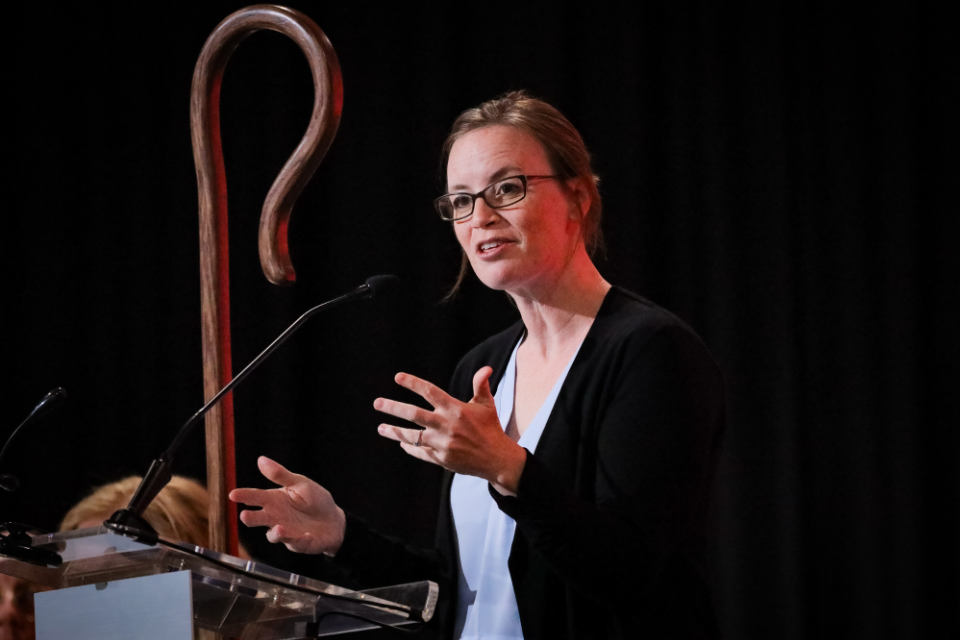
In this interview, author and historian Dr. Ashley Boggan discusses her passion for history and what draws people to Methodism, and offers a sneak peek at what she’ll present to lay and clergy members next week at the 2026 Michigan Annual Conference.
JAMES DEATON
Content Editor
A central theme of the upcoming 2026 Michigan Annual Conference, which begins next Friday, May 29, is forming United Methodist identity — what sets us apart from other Christians and gives us our unique voice.
This is fitting, given the new season The United Methodist Church is entering, following historic polity changes at the 2020 / 2024 General Conference, the overwhelming support for worldwide regionalization, and a new vision statement that will propel United Methodist ministry into the future.
To help conference attendees better understand our United Methodist DNA, Dr. Ashley Boggan, General Secretary of the General Commission on Archives & History, will serve as the guest speaker. Dr. Boggan will speak twice: Saturday evening from 7:30 to 8:30 pm and Sunday morning from 8:30 to 9:20 am. A published author, Dr. Boggan will also host a book signing in the Governors’ Hall Prefunction after the Saturday session at 9 pm. Learn more about Dr. Boggan’s academic biography and publishing projects.
In preparation for her time with us, Dr. Boggan sat down with MIconnect to discuss her passion for history and what draws people to Methodism, and to offer a sneak peek at what she’ll present to lay and clergy members next week.
What led you to study United Methodist history and, eventually, to teach? What keeps you digging into our history?
My parents, both ordained United Methodist clergy, taught me to question everything. It’s the Wesleyan understanding of using your reason and experience fully to figure out how we understand the world. So this researcher within, this academic mind that constantly questions and seeks answers, developed within me.
One of the best places to look for answers to current problems is the past, to see why certain systems were built up and how we got here. What did we do right? What did we do wrong? Eventually, after college, I discovered how quirky Methodists were in the 19th century and how different that was from my United Methodist experience growing up. That led me to ask how we got from people who were known as “shouting Methodists” to very mainline?
So that’s the inquiry that really set me on the path. And then I kept finding wonderfully weird, fascinating, and hope-filled stories that kept me coming back. Today, I see that doing the work of history, doing the “ministry of memory” as we call it, is very much an act of my faith and helps me discern and process what’s going on in the world around us.
Who is your favorite person from Methodism that we have never heard of? Could you share a bit about them and explain why we should learn about them?
One of my favorites is probably Rev. Dr. Anna Howard Shaw. Her ministry in the Methodist Episcopal Church began in the 1870s. She was among those who petitioned the 1880 General Conference for ordination rights but was denied. She then went on to be ordained by the Methodist Protestant Church, which had been ordaining women for about 15 years by then.
Shaw is one of the first female seminary students at Boston University School of Theology. She graduates from there and then begins pulpit ministry in and around Boston, where she is given a two-pulpit charge of congregations that were warring against each other. So, Shaw learns that pulpit ministry might not be her calling and ends up going back to school, graduating with a medical degree, and largely trying to better the world around her using her theological training and her medical knowledge.
She was very concerned with alleviating poverty among women and children, addressing the conditions that kept them down. She ends up joining the women’s suffrage movement, is beloved by Susan B. Anthony, and eventually serves as president of the National American Woman Suffrage Association for 11 years. Under her, many states began granting women voting rights. During World War I, she ran the Women’s Committee of the Council of National Defense and was the first woman to receive the Distinguished Service Medal.
She’s a really big figure that not a lot of people pay attention to. She had her hands not only in the Methodist world but also in women’s suffrage and government matters. As a fun fact, some may recognize her from the television show “30 Rock.” In one episode, the main character decides to celebrate Valentine’s Day as Anna Howard Shaw Day. Shaw was born on February 14.
Your biography states that you come from a long line of Methodists. Would you consider yourself dyed-in-the-wool? Did you ever leave your roots and come back? If so, what brought you back? If not, what has kept you here?
I was going to United Methodist church camps when my mom was pregnant with me! Growing up, I was a double preacher’s kid, with both of my parents serving in the Arkansas Conference, so you can see I didn’t have a choice.
Once I got to college, I became less of a frequent churchgoer, just because three services every Sunday for 18 years might do that to you. I figured I had banked some hours. But no, it never left me, and I’ve never left the church. I have been very frustrated with the church at times, but I keep coming back, choosing to fight the good fight from within the system rather than leave it.
What would you say to those who came to United Methodism as adults, later in life, and now find a home here? What do you think we bring to the fold as “outsiders”?
I’m always curious what draws people to United Methodism, especially if they weren’t cradle Methodists, as we like to say, because I think that speaks to some of the characteristics that The United Methodist Church holds.
For some, it’s the closest church to where they live, or it has a good youth ministry, or whatever, but there’s something that pulls people in and keeps them sticking with it. And so I love being in conversation with those folks and seeing what it is.
A lot of the time, when I’m in conversation with folks, what keeps them coming back is a sense of welcome or inclusion. I love that fact. I think that, on the ground, most local churches are very welcoming environments. And then my historian and bureaucratic view asks whether we are as inclusive on paper as we are in practice, and vice versa. I like to ensure that and look at the tension between those two things.
From your experience and research, do you think Methodism attracts or draws certain types of people, whether it’s personality, theology, or life experience?
I would say early on, and this was true in John Wesley’s day and in early American Methodism, that Methodism was designed and meant for outcasts and those on the outskirts. In Wesley’s day, I believe it’s like 80% of the people who identified as Methodist were below the poverty line, and it stayed that way for a few decades when it became American Methodism.
By the Civil War, we’re moving toward middle- or upper-class membership, but early on, it’s this notion of plain speech for plain people, as we are here trying to bring people in who the world has cast out. And so, alongside that, early Methodists, both in England and in America, pushed society to be better. They were a pain to most governments and policies!
I wish we would reclaim that boundary-pushing, especially today. So, I would say it’s that notion that we didn’t appeal to the elite and the upper classes on an exclusionary basis, as other faiths did. We were very much centered on the poor and the outcast, tending not only to their souls but also to their bodies, usually their bodies first.
What are the top three hallmarks of United Methodism that set us apart from other Protestant Christians? What do we offer the world that is compelling?
This is taking us way back to our roots. In the 18th century, there wasn’t a lot to be happy about. And when the dominant faith is Calvinist, which is one of fear [centered on election and predestination], you don’t know where you’re going to go. Plus, if you have any idea or any hint that you might be saved, then that’s a good sign that you’re not.
Methodists, with their beliefs in universal atonement and the doctrine of assurance, knew they were destined for heaven and found comfort in that. As a result, they were free to be joyful. They experienced a joyful faith, not a fearful one.
Second, I might say “vile-tality,” this notion that I refer to in my scholarship, of pushing the boundaries to ensure that more and more people are included within God’s kingdom.
Finally, I’d say action. John Wesley was a practical theologian, not a systematic one. So we are people who get out and do. We aren’t people who sit and think. We usually do and then think.
Following the COVID-19 pandemic, the season of disaffiliation, and the historic 2020 / 2024 General Conference, name three things that give you hope for the future of United Methodism.
After the 2020 / 2024 General Conference, for the first time in our history, we are not excluding anybody on paper. And I think that’s huge. But that leads me to ask, now that it’s on paper, is it there in practice? We will see. But on paper, we are not excluding anybody from any ranks of ministry or membership, and that needs to be named and celebrated.
I find hope in the new vision statement. I think it is grounded in our identity. I also think it’s action-centric and pulls us forward toward being better, constantly seeking perfection.
And I find hope in the fact that we’re actually doing the work of asking the hard questions we haven’t asked before — questions of identity, what sets us apart, what our witness is in 2026 as The United Methodist Church, and whether our structure matches our theology.
We’re finally digging in, asking those questions, and actually looking for answers. Hopefully, we will listen to those answers once we’ve done the research and discernment. But previously, when we had different splits, we didn’t do this work. We just kept going because we were afraid that if we took a stance or claimed an identity, we would upset more people and they would leave. But now we’re actually doing the work of identity reclamation.
Could you give us a preview of what you’ll share during the 2026 Michigan Annual Conference? How can conferencegoers prepare for our time with you?
The teaching session on Saturday night will focus on your conference theme, “Love Boldly,” and how Wesley and early Methodists loved boldly. We will be doing the work of grounding us in who they were and the work that they did.
For the Sunday morning session, we’re going to look at how American Methodists have loved boldly. So, looking at how we have used our faith in action to address injustice, address the connections to different -isms, racism, sexism, heterosexism, all of that. The second session will be a bit more contemporary, and the first one will be really grounded in Wesley.
I will probably cement some of this in my love of John Wesley’s submission to be more vile. And so we’ll dive into that and how that’s a marker of our identity and how, at least my interpretation of being more vile, that leads us into loving more boldly.
People are welcome to read “Wesleyan Vile-tality: Reclaiming the Heart of Methodist Identity,” if they would like. Otherwise, just come with open ears and an open heart, and don’t think of this as a regular history lesson. I’ve been told I make history fun, so I don’t want to set the bar too high. I’m just excited to be in Michigan and to share all this with you.
One more thing: The Sunday morning talk will most likely focus exclusively on women because this year we are celebrating 70 years of women’s ordination and full membership rights in The United Methodist Church. So, in all of the annual conference talks I’m doing this year, 14 talks at eight annual conferences, I’m highlighting women and doing this work of uplifting and naming the ministry and the missions that they have done, even with or without ordination or without full membership rights, as a way of honoring their legacy, and I will be wearing red. (Why wear red? Learn more.) So I encourage everyone to wear red to honor women’s fight for ordination as well. Wear it for any part or all of annual conference!
Is there anything else you’d like to share about your ministry? How can we follow your work?
There’s a lot of good stuff out there that the General Commission on Archives & History is producing. Check out our “Radicle Methodism” and “Rooted Methodism” online courses via the UM History Hub. We also have the “Un-Tied Methodism” podcast. Also, we’ve just produced a new video series in step with the celebration of our nation’s birthday: “From Crown to Conferencing: Methodism and the New Republic.”
I would encourage Michiganders to follow us on social media. That’s the best way to get updates on resources and the latest podcast or course, and to learn what we’re doing. Follow us on Facebook, Instagram, and TikTok.
The publication of this interview was made possible thanks to generous financial gifts from local United Methodist churches in Michigan through Ministry Shares. Thank you! Learn about the impact of Ministry Shares on mission and ministry in Michigan and around the world.
Last Updated on June 3, 2026