

Judy Bowman, a Detroit artist with United Methodist connections, has spent recent years illustrating the rich cultural history of Detroit’s east side and paying tribute to the resilience of Black communities in the face of forces that seek to diminish their contributions.
FAITH GREEN TIMMONS
Michigan Conference Communications
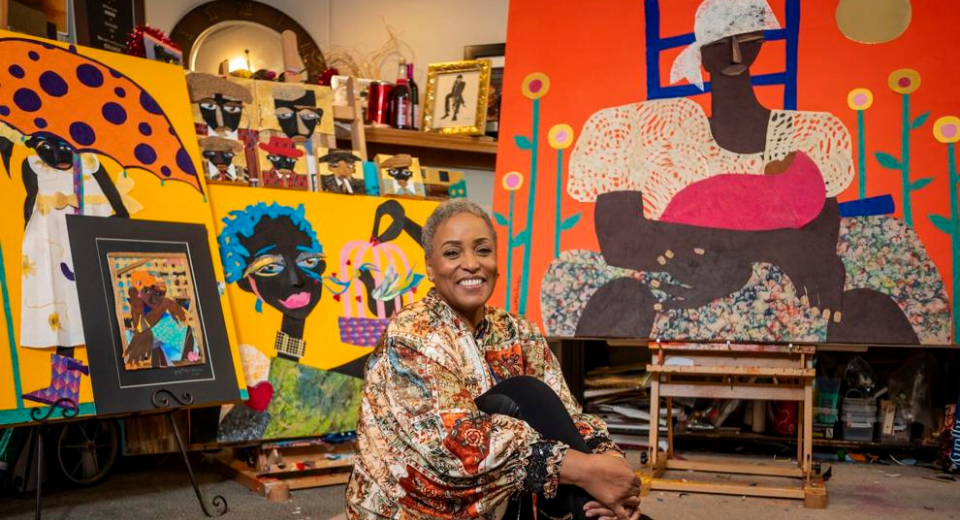
Detroit artist Judy Bowman considers herself a visual griot, or storyteller. Renowned for her multifaceted historical art expressions, Bowman has made a name for herself by depicting celebratory scenes of days gone by that are informed by her experiences growing up in Detroit. Her art serves as an educational tool, emphasizing the cultural heritage of the city’s east side and enlightening people about African American history.
Bowman and her family lived in Black Bottom, a name bestowed by early French settlers struck by the horticultural potential of the area’s rich, dark soil. Black Bottom was a low-lying, nutrient-rich floodplain ideal for farming, yet it was also risky for establishing stable infrastructure.

During the Great Migration, when former slaves seeking better lives ventured north in search of industrial jobs, Black Bottom was one of the few places where they could purchase homes. Despite the challenges of segregation, Black Bottom was a vibrant community, rich in culture and history, and a testament to the resilience of the African American spirit.
Despite the challenges of segregation, Bowman celebrates the unique opportunity this forced enclave provided. “Black Bottom was an incubator for Black talent, education, and empowerment,” says Bowman. “It was vibrant. We lived together in one general area due to redlining. Yet, that fostered a strong sense of community togetherness, caring, confidence, and support. We looked out for one another.”
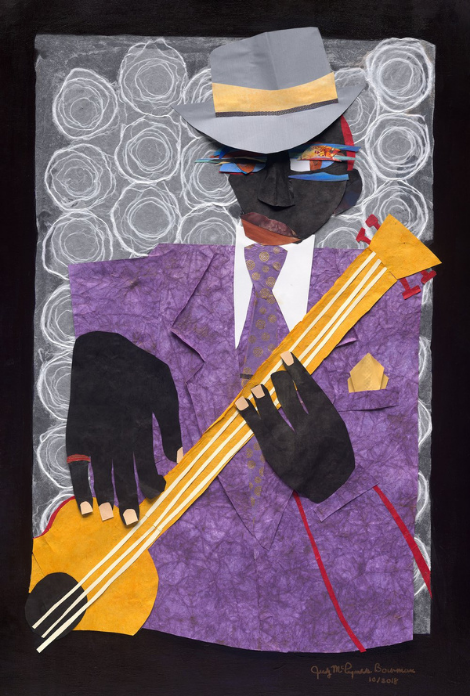
By using vibrant hues, textured paper, and acrylic paint, she expresses the richness of her coming-of-age experience in Motown. While she does not focus specifically on calling out institutional racism, her efforts do challenge prejudicial mindsets that may dismiss, or even seek to diminish, significant Black contributions, expressions, or experiences. Bowman does this by presenting a more realistic picture informed by her upbringing.
Handmade, globally sourced archival paper, coupled with pastes, adhesives, and tints, are all tools that she uses to add depth and detail to her intricate designs, depicting Detroit’s Black Bottom. Bowman explained that there were many positive role models. “We were a proud community,” she says, “and we were all pulling for one another. Excellence was not an option. The skills and talents of prominent doctors, teachers, lawyers, artists, authors, poets, musicians, preachers, and successful Black business professionals were groomed and produced there. We all lived together, supporting one another.”
Today, nothing is left of Black Bottom. It was destroyed to make way for Interstate 75 and the I-375 expressway. As a result, the government paved over minority-owned land, uprooted homes, demolished commercial buildings, and destroyed Paradise Valley, a lucrative business district. Residents and property owners were given only 30 days to vacate and offered no equitable compensation.
Under the guise of urban renewal, the entire area, once vibrant with cultural expression and ethnic heritage, was upended. Federal funding designated for revitalizing blighted areas displaced thousands of working-class and middle-class homeowners and renters, causing most of the district’s businesses and institutions to crumble.
Before that, Black Bottom’s bustling business district and entertainment hub lasted 30 years, from the 1920s to the 1950s. It was also a thriving mecca for the arts, a significant cultural center, and a socially substantial site known to African Americans nationwide. Black Bottom was widely popular for its minority-owned hotels, restaurants, and Black entertainment venues. This was especially important given the fact that segregation limited where blacks could safely gather, rest during travel, or reside.
Soul singer Aretha Franklin, Touched by an Angel TV star Della Reese, legendary boxer Joe Louis, and Nobel Peace Prize winner and United Nations official Ralph Bunche all hail from Black Bottom. As did blues guitarist John Lee Hooker, Detroit’s first Black mayor Coleman Young, and Michigan’s first Black U.S. House Member Charles Diggs, Jr. In addition, great performers of the day, like Duke Ellington, Ella Fitzgerald, Count Basie, Dinah Washington, Billie Holiday, Bessie Smith, Nina Simone, and Etta James, all frequented the area like a second home.
The region’s demise was a tremendous loss for those dependent on what Black Bottom uniquely offered. Its demolition stifled the great potential for generational wealth-building that had painstakingly taken former slaves decades to build. The impact of that economic setback is evident to this day.
With merely 30 days’ notice, before the homes that they owned or rental dwellings they occupied were set to be destroyed, scores of families were forced into public project developments, unable to rebuild or rebound. Some descendants — children, grandchildren, and great-grandchildren — have yet to recover or regain the livelihood that they lost.

In 1966, two vital Black churches were forced to close, as a direct result of urban renewal: Detroit: Mitchell Memorial Methodist Episcopal Church, established in 1930, and Detroit: Mary Palmer. For Black Methodists of that day, speaking of Mary Palmer still elicits nostalgic memories of the flourishing congregation that opened its doors in 1944. Former congregants of both churches say that they miss those strong, vibrant worship communities. After their rapid closures, parishioners say that their membership records were quickly transferred without their input. Over time, some become disconnected and dispersed.
At the time, the nearby Conant Gardens community was a relatively wealthy, stable, predominantly Black area. The ministries of Detroit: Conant Avenue UMC span from that era. Conant Avenue’s community contributions are a testament to its continued viability, offering weekly fitness and Zumba classes, a Children’s Defense Fund Freedom School Program, and co-sponsoring a successful annual Urban Methodist Youth Camp, under the direction of Rev. Audrey Mangum, one of the new ordinands the Michigan Conference celebrated in June.
A point of great pride for people from the aforementioned churches of that era is their belief in their role in molding and developing the highly respected and influential Bishop Woodie White. He served as a pastor in Detroit before becoming the first General Secretary for the Commission on Religion and Race, and the first person of color to head a United Methodist general agency. White was elected bishop in 1984 and retired in 2004. Considered a Methodist pioneer, Bishop White was tasked with overseeing the merger of the Central Jurisdiction (which was all Black) and the geographical annual conferences.
Judy Bowman also has a place in Michigan’s United Methodist history. For nearly 20 years, she served the role of “first lady,” an honorific title, at Flint: Bethel UMC. It was a season of exponential growth for the congregation during Rev. Dr. Russell McReynolds’ tenure as appointed pastor. McReynolds, who also served on the Board of Education for Flint Community Schools, was later appointed to Battle Creek before becoming a district superintendent. Rev. McReynold’s tenure as a seminary student, prior to that time, also afforded Judy a rare and unique position as her then-husband was preparing for ordained ministry. While he was studying in Atlanta, she was commissioned to create a work for both Coretta Scott King, widow of Rev. Dr. Martin Luther King, Jr., and the slain civil rights leader’s mother, Alberta King.
Bowman dedicated decades to raising a young family. She also worked as an art teacher in the public schools, while managing the expectations that tend to come with being a minister’s wife. Her projects were on hold. However, her passion remained aflame.

She eventually returned to Detroit, where she became the principal of the Detroit Academy of Arts and Sciences (DAAS). DAAS is an innovative fine arts school focused on fostering creativity. Upon her retirement in 2010, she rebooted her artistic career.
In the decade and a half since, Bowman has designed acclaimed art abstracts featuring stunning images that depict the history of what was, rather than focusing on what has been lost. The process is therapeutic and soothing for her and awe-striking for onlookers and observers. Each piece offers a reimagining of the iconic Black Bottom era. Her award-winning collections help tell of what that community accomplished, what was nearly forgotten, like a page ripped out of Detroit’s history book and almost discarded. Bowman is famous for her masterful mixed-media collages. She is respected for capturing the essence of a thriving culture despite several indignities that were never fully rectified.
Her exhibits are on display in galleries from Detroit to Spain. The art world has truly taken notice of her distinctive, memoir-like expressions, which make an impact and impression that are difficult to forget. Her work is displayed in our nation’s capital, in locations such as the Hubert Humphrey Federal Building in Washington, D.C., the U.S. Department of State, the Art Bank Program, Georgetown University’s Booth Family Center for Special Collections, and the special library at GTOWN. Plus, the Flint Institute of Arts, the Detroit Institute of Arts, and the Charles Wright Museum.
Prominent collectors value her gifts and talent. She is a respected guru who has received numerous acknowledgments, accolades, and prestigious awards, including the 2022 Alain Locke Recognition Art Award, the 2021 Kresge Fellow for Visual Arts, the 2018 Regional and National Sapphire Artisan Series Competition for Detroit, and the 2018 Essence Festival, among others.
Bowman’s perspective as a well-traveled artist helps raise awareness of a disturbing, ongoing trend. Her pleasant recollections of a safe and comfortable upbringing in a beautifully vibrant area do not match those of the entities that deemed the area unlivable and designated it for destruction. At 71, she has heard similar tales time and again from around the globe, primarily in areas inhabited by people of color. There are many little-known or unacknowledged travesties of justice, like the one perpetrated by Texan enslavers from 1882 to 1885. They kept free people enslaved by hiding the truth, exploiting their lack of knowledge. Blacks in Texas remained in bondage until the message specifically reached them. President Abraham Lincoln declared their freedom the moment he signed the Emancipation Proclamation, yet nothing changed until troops arrived to announce it. Figuratively, griots serve a similar role to that of Union troops, arriving in Galveston two months after the end of the Civil War. What those Black soldiers shared was history; it explained what happened a couple of years before. Yet, it liberated those remaining unjustly in captivity, because they had yet to learn. Our Juneteenth holiday, held on June 19 each year, celebrates this news reaching them.
Keeping Black Bottom’s residents, entrepreneurs, and clients ignorant of the specifics involved in redevelopment deprived an entire community as well. The lack of transparency left them with no redress, akin to the actions of Texan slave owners. City officials, state legislators, and the federal government left Black Bottom in the dark about details intended to displace them to expand an interstate.
Bowman’s imaginative art renews hope through her heartfelt recollection. Each canvas and print leaves an indelible mark, testifying to the accomplished, thriving, resilient home life that Black Bottom afforded her and many others. Her award-winning designs are cementing nostalgic memories of Detroit’s Black Bottom into history, despite the fact that decades ago, it was paved over. Her artful memoirs hold great promise for being shared around the world and displayed for decades to come.
That is what she means when she refers to herself as a visual griot: She employs the power of her paintbrush, coupled with many inventive mediums, to transmit the cultural narrative, traditions, and history of Detroit’s east side. She recalls a once-thriving area, not a community in survival mode. She has made a career of paying tribute to the triumph of those who have been challenged by trauma.
Learn more about Judy Bowman and her art on her website: judybowman.com.
Last Updated on July 16, 2025