
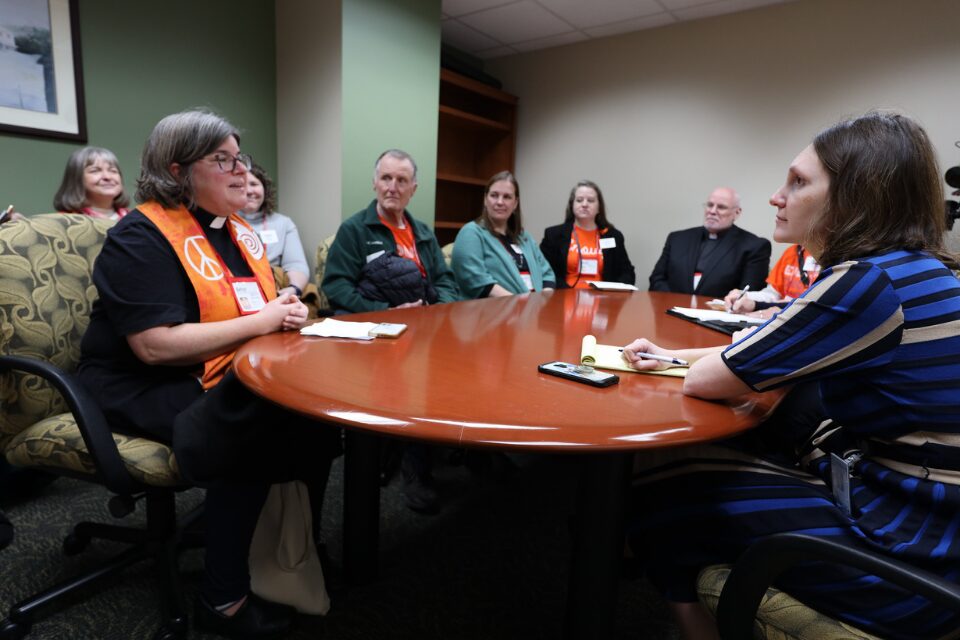
On March 18 at Advocacy Day, United Methodists have a chance to help reframe the narrative around food insecurity by advocating for their neighbors, who are worthy of investment.
JAMES DEATON
Content Editor
Feeding hungry people is in our wheelhouse as United Methodist Christians, and Dr. Phil Knight celebrates it. It’s part of who we are, he says, and we’re good at it. We know this to be true — just think about how many of our local churches, campus ministries, and EngageMI ministry partners across the state step up when the need arises. Read these stories as reminders.
Dr. Knight is the executive director of the Food Bank Council of Michigan, our community partner for Advocacy Day 2026, which will be held on Wednesday, March 18. Learn more and register now. Knight experienced Methodist faith formation firsthand, having grown up in a United Methodist church in Alabama, and so he affirms faith in action when he sees it.

“One of the things we’re going to be held accountable for is how we treat the poor,” says Knight, alluding to the words of Jesus in the Gospels. “The fact that so many United Methodist churches are involved in basic needs, including food, shows that we’re doing what we were instructed to do: Feed the poor. And I don’t care what language you translate that scripture into; it says the same thing. So, it’s good that we’re doing this work.”
We see it when we host food distributions in the church parking lot, operate a food pantry in the church basement, deliver hot meals to older adults on fixed incomes, and fill backpacks with easy-to-prepare meals for children to make over the weekend. These ministries of mercy help people avoid the physical pain of hunger. It’s the work United Methodists are called to do.
Part of Knight’s role as head of the Food Bank Council in Michigan is feeding hungry people as well. He chaired Governor Gretchen Whitmer’s Food Security Council, which produced food security recommendations that have been implemented, including universal school meals. When federal SNAP benefits were at risk during a government shutdown last year, the Food Bank Council mobilized to distribute $4.5 million in food and, through its network of seven regional food banks, provided approximately six million meals over three weeks. Many United Methodist feeding ministries rely on this robust network of food resources.
But Knight and the Food Bank Council go beyond food distribution to address systemic and policy changes that would eradicate food insecurity. Food insecurity, as defined by the USDA, is “the limited or uncertain availability of nutritionally adequate and safe foods, or limited or uncertain ability to acquire acceptable foods in socially acceptable ways.” In essence, it’s when people don’t have enough nutrient-rich foods to eat and are unsure where to obtain them.
Nutritious food provides immediate economic, stabilizing, empowering, and health benefits to households, and when individuals do not have it consistently, they cannot thrive and become all that God has created them to be.
Knight believes food insecurity is solvable because it is a human-made social problem. It’s part of his belief system; it’s one reason why he gets up every day to do the advocacy work he does.
“I believe with every fiber of my being that this is a solvable problem,” Knight confesses. “I don’t think you’ll ever solve a problem you don’t think can be solved. You won’t even think about it. So first, you have to believe, and I believe it can be solved because food insecurity is a man-made problem. We created it, so we can uncreate it.”
According to Knight, ending food insecurity will require, in part, what the Michigan Conference is doing through its annual Advocacy Day. It’s when we share stories of impact that weigh heavily on our hearts, build relationships with policymakers who can do more than we can alone to make systemic changes, and do all this courageously, consistently, and kindly.
“It takes enough voices raising the issue with the people who make decisions,” explains Knight. “I call this work you’re doing ‘influencing the influencers.’ So let’s exert that influence!”
United Methodists are in a position of influence, given our long history of advocacy and justice, particularly reflected in our feeding ministries. It’s a position that can be leveraged for good.
“Food is the answer to hunger, and people need help today, so that’s why we’re doing this work,” Knight notes. “But food insecurity is a different conversation. That’s about the conditions that keep people captive under the toxic stress of what am I going to eat today, and what am I going to give my children? What you’re asking legislators to do is address the conditions that hold hunger in place. The answer to that is aligned systems and better policy.”
Knight stresses that solving food insecurity requires addressing systemic policy failures — such as income thresholds that abruptly cut off benefits rather than scaling them, creating financial cliffs for working families.
He continues, “United Methodists have a little bit of gravitas here in my mind because they’re doing the work of addressing hunger and helping people access the food they need every day. So if anybody ought to come to Lansing, it’s them because they put their money where their mouth is in their sweat equity. I think they have a special position to say, ‘I’m doing the work over here. Now I need you to do the work over here.’ Let’s align the systems and put in place policies that support families rather than treat them as ‘fraudulent.’ That’s a big word people use today: waste, fraud, and abuse. Is there some? Sure, absolutely. Is there as much as people think there is? No way.”
Another significant part of what United Methodists are called to do in Lansing on Advocacy Day is to help reframe the narrative around food insecurity and who receives food resources. Through honest storytelling, by putting faces on the issue, we can begin to shift lawmakers’ — and our own — mindset about how we view the people who need food.
Knight calls on United Methodist churches already engaged in feeding ministries to advance advocacy by helping change how society perceives people experiencing food insecurity — not as “takers” but as worthy neighbors and resilient individuals deserving of our care and investment.
Food, he reminds us, communicates value, and as people of faith, how can we do anything less?
“We just finished the holidays,” says Knight. “If someone’s coming to visit and we like them, we wonder what we can prepare for them. What’s the best dish I make? I’m going to make that for them. Why? Because we use food to communicate value.”
He concludes, “Food insecurity is in every ZIP code, every community. . . . What I believe we need to talk about is what difference the food makes. And that the vast majority of those coming are the most resilient people you will ever meet. They handle the stresses of life with fewer resources than most of us, yet they are full of agency. They want to solve their own problems. They want to be financially free and have the same liberty as you and me. And if a little bit of food for a little while helps them get there, one of my friends would say it like this, ‘If it does you so little harm and does someone else so much good, why wouldn’t you do it?’”
What stories about hunger or food insecurity can you share with lawmakers on Advocacy Day on March 18 in Lansing? How can you help rewrite the narrative about our neighbors, created in God’s image and worthy of our love and care, receiving food benefits? How might you live out your United Methodist faith and stand up for lasting change for the common good?
Learn more about Advocacy Day and download resources to share news about this event with others.
Register for the February 11 lunch-and-learn and hear more about the topic for Advocacy Day 2026.
The promotion of Advocacy Day each year is made possible thanks to generous financial gifts from local United Methodist churches in Michigan through Ministry Shares. Thank you! Learn about the impact of Ministry Shares on mission and ministry in Michigan and around the world.
Last Updated on February 9, 2026