
The Michigan Conference celebrates increased financial giving in 2025 and thanks local churches for their commitment to connectional ministry within our conference and beyond.
JAMES DEATON
Content Editor
The Michigan Conference released its 2025 year-end financial report, and there is good news to share. Last year, local United Methodist churches increased overall financial giving through Ministry Shares by 2.4%, raising the total collection rate to 80.8%, up from 78.4% in 2024.
There are 539 local churches that pay Ministry Shares, and 350 of them paid 100% or more of their apportionment. These statistics indicate that 65% of local churches met their 2025 Ministry Shares budget.
See how much your local church gave in 2025.
There are more encouraging signs to celebrate. In 2025, 23 churches increased their giving by 50% or more. Fewer churches paid $0 in 2025 than in 2024, and at least 8 churches that gave $0 in 2024 contributed something in 2025. The Western Waters District was the only district in which all local churches contributed to their Ministry Shares budget.
The conference also spent less than anticipated. In 2025, the conference spent $7,549,094 against a budget of $8,493,144. Although expenses were reduced and overall Ministry Shares giving increased, the conference still had to draw on reserves to cover the shortfall. In 2025, $6,718,330 was collected, leaving the conference $830,764 short of the $7.5 million spent.
The Michigan Conference celebrates local churches that gave generously and abundantly and those that gave as they were able, given their context and circumstances. The faithfulness of United Methodist congregations through Ministry Shares provides vital financial support, sustaining congregations, raising up bold and effective leaders, and empowering Christ-filled mission and ministry here in Michigan and worldwide.
“We are so grateful for the generous donations from all churches that contributed in 2025!” said Angie Anger, Chief Financial Officer. “It is heartening to see the improvement from the previous year, and we’re thankful that churches that might have been struggling over the last few years were able to contribute. Every gift is significant as we partner together in shared ministry.”
Looking ahead to this year’s giving, the overall collection rate for January 2026 was 3.8%, 1.3 percentage points higher than in January 2025. Conference leadership hopes this news, along with the positive trend shown in 2025, signals more dialogue and awareness of the impact of financial giving and a slight mindset shift within the conference as healing continues post-disaffiliation, local churches rediscover focus post-pandemic, and United Methodists find value in connectional ministry.
Rev. Leslee Fritz, Special Assistant to the Bishop for Mission and Budget, works closely with the finance staff and the Conference Council on Finance and Administration to help interpret annual conference budgets. She sees the impact of better communication within the Michigan Conference on how Ministry Shares relate to local church ministry and budgeting.
Fritz noted, “The conversation about our need for all churches across the conference to do their part to help fund our shared ministries and mission is having a positive impact. We are grateful for the many churches that made this a priority in 2025 and believe we will continue to see positive growth this year.”
This shift in giving coincided with the release of the denomination’s new vision statement, one year after the historic 2020 / 2024 General Conference. The statement reads: “The United Methodist Church forms disciples of Jesus Christ who, empowered by the Holy Spirit, love boldly, serve joyfully, and lead courageously in local communities and worldwide connections.”
General Conference set The United Methodist Church on a new path, and the ratification of several constitutional amendments, including worldwide regionalization, in November 2025, put many significant legislative decisions made at General Conference into motion.
Regarding worldwide giving, the General Council on Finance and Administration (GCFA) also recently published its year-end financial report, summarizing The United Methodist Church’s financial position. As part of its covenantal commitment, the Michigan Conference allocates 28% of all Ministry Share dollars received from local churches to the worldwide church.
The GCFA report showed that the overall collection rate across all conferences worldwide in 2025 was 83.9%, 13.3% higher than in 2024. However, in total dollars, connectional giving was $17.9 million lower because of the reduced base rate set at the recent General Conference.
Change within the church sometimes happens incrementally, but shifts in UMC polity and a renewed vision of an inclusive, equitable church structure offer glimmers of hope for what the church can be in the future.
In the Michigan Conference, the ripple effect of these major denominational changes will take time to be seen, but even so, local churches in Michigan are moving in the right direction in their commitment to The United Methodist Church, both missionally and financially.
Faith, as any United Methodist will tell you, is rarely tested in the easy moments. Three local congregations shared how they’ve chosen generosity over uncertainty — and what that commitment to our shared ministry has meant for them.
Gwinn UMC
Gwinn UMC is a rural church located about 20 miles south of Marquette in the Upper Peninsula. During the season of disaffiliation, the congregation faced a critical moment when a narrow vote to remain part of The United Methodist Church led to the loss of a third to half of the congregation, including their pastor.
The congregation has leaned into a spirit of courage and resilience as they have navigated the painful challenges arising from disaffiliation. They have recommitted to being United Methodist and have focused on Holy Spirit-filled, Bible-based worship, with multiple lay members stepping up to lead services, and on strong outreach, both to homebound members and to the community.
Pastor Billie Kay Ladwig, who grew up in the church, took on a leadership role, initially offering to serve as pastor without pay, driven by a desire to give back to the community that has supported her. With guidance from the district, the church has become financially stable, transitioning to a quarter-time pastor role for Ladwig and selling the parsonage. To improve ministry efficiency and communications, the church has adopted the single-board model of church governance.
All of these factors have contributed to increased giving to Ministry Shares. For 2025, Gwinn UMC contributed 78% of its budgeted amount, up from 8.8% in 2024. For a modest congregation with an average weekly attendance of 30, this is significant.
Also, the advocacy of specific lay leaders within the congregation helped guide them toward financial security and keep the conversation going about the importance of connectional giving and ministry. Judy Watson-Olson, as the congregation’s finance chair, gave much-needed wisdom on balancing the church’s budget and keeping them apprised of necessary changes.
Catherine Stephenson, a worship leader and member of the church council, kept advocating for the church to uphold its commitment to Ministry Shares, even when they didn’t know whether they could buy coffee for fellowship time. But she saw the value in our shared ministry.
Stephenson explained, “I’ve been a long-time lay member to annual conference. So, in my experience, I knew where it was going, and I valued the connection among our local church, the district, and the conference. It was important to me that we, as a local church, don’t become insular, that we think beyond ourselves. It’s the same with missions. It’s really easy to keep all our money to ourselves, but it’s not going to grow us if we don’t give. We need to reach out.”
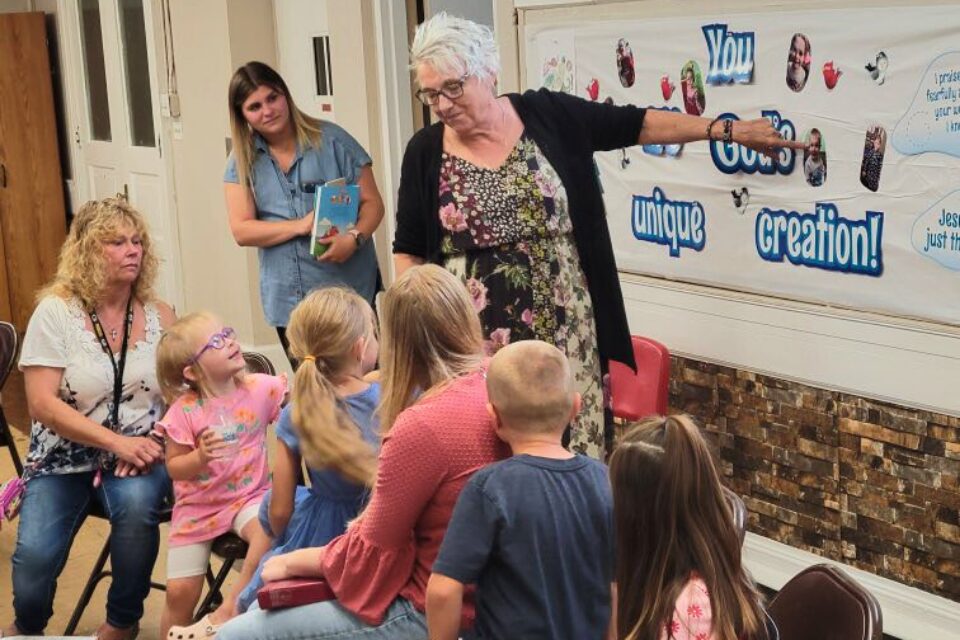
Outreach remains a core value, with Pastor Billie actively visiting and providing communion to members in assisted living facilities, maintaining connections with those who cannot be there in person. The congregation also reaches out to the community in a variety of ways, including bringing lunch to those working on Habitat for Humanity homes and donating money to schools for winter clothes for children. The church has also seen a revival in its children’s program, with young families returning to church and contributing to Sunday school, which had been absent.
Overall, Gwinn UMC has navigated its losses and challenges with a focus on community, outreach, and spiritual growth, demonstrating a commitment to its core values and mission.
Mount Clemens: First UMC
Mount Clemens UMC, located in the county seat of Macomb County, is in an urban setting just north of Detroit. The congregation is deeply committed to The United Methodist Church’s connectional ministry. The church, one of the oldest United Methodist congregations in the state, prides itself on paying 100% of its Ministry Shares, a goal achieved through the efforts of past leadership and the congregation’s ongoing dedication.
Since Rev. Tom Hoffmeyer’s arrival as pastor in July 2025, the church has continued to emphasize its connectional ties by participating in district ministries and conference activities and supporting the path The United Methodist Church is on following General Conference.
The congregation is actively involved in various conference and district ministries, including joining other United Methodists in Lansing for the Michigan Conference’s annual Advocacy Day, sending kids to camp at Lake Louise Christian Community and Lake Huron Retreat Center, and participating in The Church Has Left the Building, a community service day sponsored by the Greater Detroit District. Mount Clemens has also been involved in outreach efforts, including mission trips to Henderson Settlement, an EngageMI national ministry partner in Kentucky, and God’s Country Community Ministries, another EngageMI partner in the Upper Peninsula.
The congregation’s commitment to The United Methodist Church remains strong, with a focus on inclusivity and community engagement.
“I think people are excited about the direction our church is taking,” said Hoffmeyer. “We are free to do the ministry we’re called to do and truly be the welcoming church we’ve aspired to be. I think what happened at General Conference validated this congregation’s call to be an inclusive and welcoming church. So we’ve sponsored Macomb County Pride, a festival celebrating the LGBTQ+ community, and I’m proud of that.”
Hoffmeyer continued, “I’m proud of this congregation’s work with the unhoused. I’m also very proud of our children’s ministry, which is led by our deacon, Rev. Alicea Williams.”
Regarding their financial commitment to Ministry Shares, Hoffmeyer says, “It feels good to be able to do our part in helping the conference and district ministries and to work with other churches to make a greater impact in our region and beyond what we could do by ourselves. And getting there is important. And I know it sometimes is a challenge, but it feels great to be able to be a part of the connection and to do what we can to support that work.”
Rochester Hills: St. Luke’s UMC
St. Luke’s UMC is located in the prosperous Rochester Hills suburb of Detroit. Rev. Scott Manning has served St. Luke’s since 2016, helping the congregation navigate challenges, including a deteriorating parking lot and relational issues within the congregation. The church averages 40 attendees on Sundays, and membership has stabilized at 120, though growth remains a challenge. St. Luke’s is committed to inclusivity and community outreach, actively supporting EngageMI ministry partners, including the Baldwin Center in Pontiac.
The church values its connectional ministry, recognizing the various levels of support from the Michigan Conference and The United Methodist Church as a whole.
Manning summarized, “We know the work of the bishop, the cabinet, and the pension board. We also know the educational and worship development pieces. Along with that, we recognize and celebrate the efforts of the denomination and the work we do together, including UMCOR, our missional outreach around the world focused on healthcare, education, and social justice. All those pieces are important, and our giving supports all that.”
Financially, St. Luke’s has struggled to make Ministry Shares payments due to local constraints, but it achieved 100% payment for 2025 after reaching 70% in 2024.
“It has never been that we did not recognize the shortfall or that we did not care,” said Manning. “Part of it is that we have to keep the lights on and pay steep city inspection fees, because one of our constraints at St. Luke’s is the high cost of having a church building in the city of Rochester Hills.”
St. Luke’s is managing those expenses carefully as it seeks to support connectional ministry. What has also helped ease the financial burden locally is the request for support from the bishop and cabinet to create a two-point charge with Clawson UMC. That was granted in 2022, with Manning’s service at St. Luke’s at three-quarters and Clawson’s at one-quarter.
The church’s commitment to connectional ministry remains strong, as it focuses on sustainability and on overcoming financial constraints to support broader denominational efforts. St. Luke’s also has a heart for outreach ministry and supporting those in need, as illustrated by its support of the Baldwin Center and a new ministry, The Helping Network.
The Helping Network supports immigrants at risk of deportation, with St. Luke’s serving as the fiduciary agent to ensure privacy and accountability. The community coalition provides legal aid and food assistance, with contributions from community members and organizations.
Editor’s note: The Michigan Conference has created a web page dedicated to information about Ministry Shares. Review it to see how much your congregation gave last year and where you are in giving for this year. There are also resources for leaders who are improving communications and education within their congregation as they work toward their financial-giving goals.